

Last Updated: November 22, 2026
Quick Summary
To reduce metal roof heat, start with ceiling insulation and reflective sarking under the sheeting, then add balanced roof ventilation with matched eave and ridge vents. Fix gaps and seals first, as these are the cheapest effective steps, before considering a reflective coating or lighter roof colour.
- Reflective foil or sarking blocks radiant heat and doubles as a moisture barrier.
- Ventilation works only when intake and exhaust vents are roughly equal in free open area.
- A light roof surface runs cooler, but indoor temperature changes least of all.
- Fix gaps, seals and ceiling penetrations before spending on coatings or colour.
- Call a professional for steep roofs, sarking under existing sheeting, or any moisture signs.
Table of Contents
- How to Reduce Summer Heat Through a Metal Roof: Start With a Diagnosis
- Metal Roof Insulation: The Biggest Single Lever
- Roof Ventilation for Metal Roofs: Let the Hot Air Out
- Cool Roof Paint for Metal Roofs and Reflective Coatings
- The Best Roof Colour for Hot Weather (and What It Actually Changes)
- A Budget-Prioritised Plan: What to Do First, Second and Last
- Moisture, Safety and When to Call a Professional
- Book a Free Roof Inspection Before the Next Hot Spell
- Frequently Asked Questions
How to Reduce Summer Heat Through a Metal Roof: Start With a Diagnosis
If your back rooms cook every February while the front stays comfortable, your metal roof heat problem is probably concentrated on one side.
Metal is a brilliant roofing material. It sheds water, lasts decades and handles harsh sun well.
Below, we show you how to reduce summer heat through a metal roof, in the order that gets results for the least money: insulation, ventilation, coatings, colour and the small fixes most guides skip.
Signs the heat is coming through the roof, not the walls
On a hot afternoon, stand in a room with a ceiling directly under the roof. Touch the ceiling. If it feels warm, heat is coming down through the roof structure. Cool ceiling, hot room?
Other signs worth noting:
- Upstairs rooms are noticeably hotter than downstairs by mid-afternoon
- The heat peaks between 3pm and 6pm, then eases after sunset
- Your air conditioner struggles on still, cloudless days more than windy ones
A north- or west-facing roof plane takes the most solar exposure, so it drives most of your heat gain. Fixing that plane first is often the cheapest win.
Metal Roof Insulation: The Biggest Single Lever
Metal roof insulation is the layer that slows heat transfer from the hot roof sheet into your living space,
Two places matter. Ceiling insulation sits on top of your ceiling joists and protects the rooms below. Roof-space insulation, usually reflective foil or sarking, sits under the metal sheeting and blocks radiant heat before it builds up in the cavity.
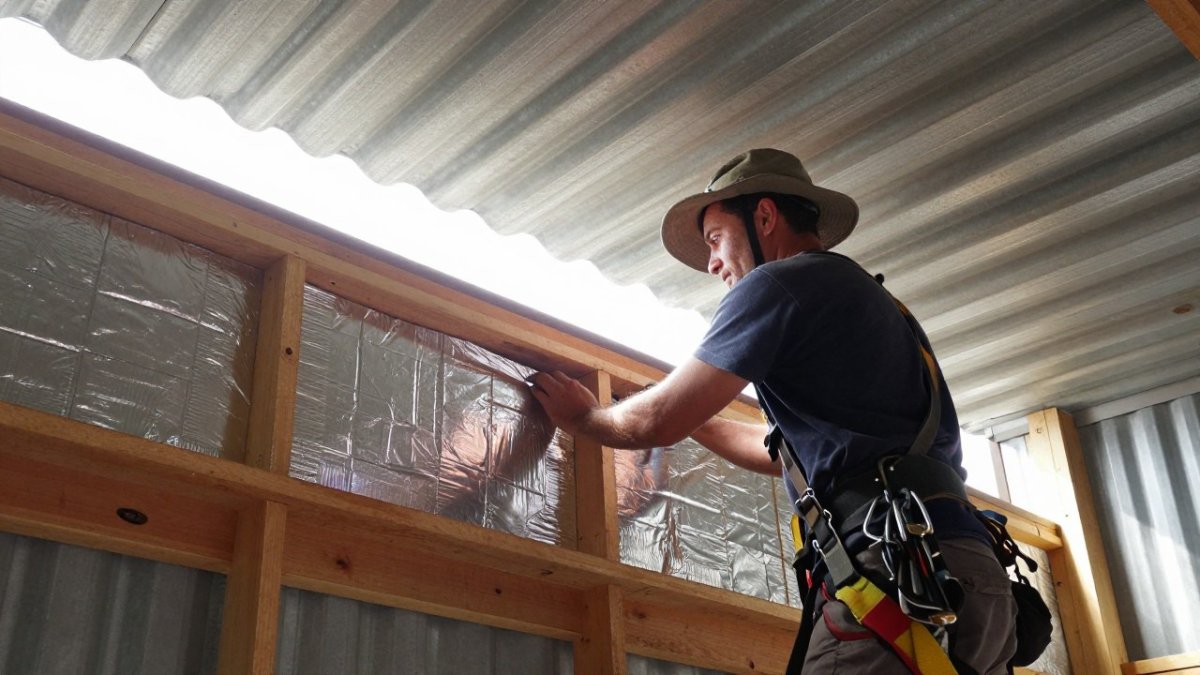
Insulation types and where each one fits
- Reflective foil or sarking: a shiny sheet fixed under the roof battens. Blocks radiant heat and doubles as a moisture barrier. Best bang for buck on a metal roof.
- Bulk batts: glasswool or polyester batts laid over the ceiling. Slows conducted heat. The workhorse of any cool home.
If your roof is old and has no sarking, adding it during a re-roof is far cheaper than retrofitting later.
Roof Ventilation for Metal Roofs: Let the Hot Air Out
Trapped hot air is part of the problem. Roof ventilation for metal roofs works by letting cooler outside air in at the eaves and pushing hot air out near the ridge, so the cavity never becomes an oven.
The key is balance. Exhaust vents without intake vents just pull air through gaps and do very little.
First, work out whether ventilation is your problem
Ventilation helps most when the roof cavity itself is the heat source. A quick diagnostic:
- Cavity is much hotter than outside air: if the roof space is dramatically hotter than the outdoor temperature on a still afternoon, trapped air is likely a factor.
- Heat eases quickly after sunset: a well-ventilated cavity sheds heat fast; a poorly ventilated one stays warm for hours.
- Upper rooms are hottest on still, cloudless days: wind-driven vents do little when there is no wind, which is a clue about which vent type suits your site.
If the cavity is not the main source, spend your money on insulation and sarking first. Ventilation is a support act, not the headline.
Sizing and balance in plain terms
Ventilation only works when intake and exhaust are matched. Practitioners aim for roughly equal free open area at the eaves and at the ridge, and avoid pressurising the cavity with exhaust-only vents, which can pull conditioned air out of the house.
Common options:
- Eave vents: the intake side. Easy to forget, essential to include.
Climate and building-specific advice
- Hot-humid climates: ventilation helps clear moist air as well as heat, but you must avoid pulling humid outside air into a cooled cavity. Balance intake and exhaust and keep sarking intact.
- Hot-dry climates: night purging works well. A cavity that vents freely overnight starts the next day cooler, which delays the afternoon peak.
- Complex or multi-storey roofs: a single whirlybird will not serve a broken-up roof. Zone the ventilation and use powered units where natural flow is blocked.
If you want to compare vent types and work out which method suits your roof and climate, our guide on improving roof ventilation breaks down rotary vents, static vents and powered units side by side.
Cool Roof Paint for Metal Roofs and Reflective Coatings
Cool roof paint for metal roofs is a reflective coating that bounces solar radiation off the surface instead of absorbing it.
Two numbers matter. Solar reflectance is how much sunlight the surface throws back. Emissivity is how well it releases absorbed heat.
Where coatings work best:
- Light-coloured or bare metal roofs in good condition
- Roofs where adding insulation is impractical
- Sheds and warehouses where internal comfort matters less than heat build-up
Where they fall short: a dark, chalky or rusting roof needs prep before any coating will hold. Coating over rust is money down the drain.
If you are weighing up coating options and what drives the cost, our rundown of cool roof paint options and costs covers coating types and how to match paint to your roof material and condition.
The Best Roof Colour for Hot Weather (and What It Actually Changes)
The best roof colour for hot weather is a light one. Pale grey, off-white, light surfmist and similar tones reflect more solar heat than charcoal or monument.
But colour is not the whole story. A light roof with no insulation still heats up. A dark roof with good sarking and ventilation often performs better than a pale roof with neither.
What colour actually changes, and by how much
Colour shifts the roof surface temperature first, then the heat flowing into the cavity, then the load on your ceiling. The effect shrinks at each step:
- Surface temperature: a light surface can run many degrees cooler than a dark one on the same afternoon. This is the largest and most reliable difference.
- Cavity temperature: the gap narrows once you account for sarking, airflow and the mass of the roof structure.
- Indoor temperature: the smallest change of the three, and the one most easily swamped by ceiling insulation, glazing and air leakage.
That is why a colour change on its own rarely transforms a hot room. It works best as part of a stack.
Orientation, pitch and the planes that matter most
Not every roof plane is equal. A north-facing or west-facing plane takes the most summer sun, so its colour matters more than a shaded south plane. Steep pitches catch more low-angle afternoon sun on the west; shallow pitches collect more midday sun and more dust, which dulls reflectance over time.
Prioritise the hottest plane. If you are repainting or re-sheeting, spend the lighter tone where the sun hits hardest and accept a darker tone on shaded planes if the design calls for it.
The trade-offs nobody mentions
- Glare: very pale roofs can throw glare into neighbouring windows and living areas, especially on low-pitch designs.
- Dirt and biological growth: light roofs show dust, lichen and leaf tannin more readily, and a dirty light roof loses much of its reflectance advantage.
- Aesthetics and resale: a light roof can look washed out against pale walls, and some buyers prefer darker tones. Colour is a long-term decision, so weigh comfort against appearance.
- Coating versus colour: changing colour usually means recoating or re-sheeting. If the existing coating is sound, a reflective coating in a similar tone may deliver most of the benefit for less disruption.
If you are re-roofing or repainting anyway, a lighter tone is a free upgrade. If your roof is dark and in good nick, spend the money on insulation and ventilation first. For help coordinating colour with walls, trims and surroundings, see our guide on choosing a roof colour scheme.
A Budget-Prioritised Plan: What to Do First, Second and Last
Most homeowners want a straight answer on order of operations. Here is how we would spend the money, cheapest effective fix first.
| Priority | Job | Rough Effort | What It Fixes |
|---|---|---|---|
| 1 | Fix gaps, seals and ceiling penetrations | Low | Stops hot air leaking in |
| 2 | Add or top up ceiling insulation | Low to medium | Blocks conducted heat |
| 3 | Add sarking or reflective foil | Medium | Blocks radiant heat at source |
| 4 | Install balanced roof ventilation | Medium | Clears trapped hot air |
| 5 | Apply a reflective coating | Medium | Cuts surface temperature |
| 6 | Change roof colour or re-roof | High | Long-term heat gain |
Start at the top. Work down as budget allows. Skipping straight to a new roof colour while your ceiling has no insulation is a common mistake.
Moisture, Safety and When to Call a Professional
Every heat fix touches moisture, and moisture is where DIY jobs go wrong. Reflective foil and sarking act as a vapour barrier.
Safety matters just as much. Metal roofs get hot enough to burn skin in summer. They are slippery when dew or dust sits on them.
Call a professional if:
- Your roof is steep, fragile or more than one storey up
- You find rust, sagging or loose fixings while checking
- You need sarking fitted under existing sheeting
- There is any sign of moisture, mould or condensation in the cavity
A licensed roofer can also tell you whether a repair is worth it or whether replacement is the better spend, a conversation worth having before you commit to a coating or a vent.
Book a Free Roof Inspection Before the Next Hot Spell
You now know the order of operations.
At Top Glaze, we have 38+ years of roofing experience across residential roofs, including cement tile, terracotta, and Colorbond and Zincalume corrugated metal.
A roof inspection can check your sarking, insulation, ventilation and sheeting, and identify what to fix first.
Request a free roof inspection from Top Glaze before the next hot spell.
Your roof will not fix itself before February.
Frequently Asked Questions
How can I reduce heat coming through a metal roof?
Work from the top down. Start with ceiling insulation at the recommended depth for your climate zone, then add roof-space ventilation so trapped hot air can escape. A reflective coating or a lighter roof colour helps on top of that by lowering how much solar heat the sheeting absorbs. If your metal roof heat problem is severe, a foil radiant barrier under the battens makes a measurable difference. Get the roof inspected first so you fix the actual weak point rather than guessing.
Does metal roof insulation stop a metal roof from making a house hot?
Insulation slows heat transfer into the ceiling space, but it does not stop the roof sheeting itself from heating up. Metal roof insulation works best alongside ventilation and reflectivity, because the sheeting can still radiate heat downward into the roof cavity. If the cavity is sealed and unvented, that heat builds up regardless of how thick the batts are. Treat insulation as the core of the solution, not the whole solution.
Does roof colour affect how hot a metal roof gets?
Yes. A light-coloured roof reflects more solar radiation and stays cooler at the surface than a dark roof, which absorbs more heat. The best roof colour for hot weather is generally a light tone with high solar reflectance and good emissivity, so it releases what it does absorb. Colour alone will not fix a poorly insulated or unventilated roof, but
Will roof ventilation help cool a metal-roofed house?
Roof ventilation for metal roofs removes the hot air that accumulates in the roof cavity, which reduces the heat available to push down into your ceiling. Ventilation works best when the roof space is also insulated and sealed against draughts from the living area.


