

Last Updated: November 12, 2026
Quick Summary
Most metal roof repair problems in Melbourne come from guessing at the leak source, missing early corrosion, choosing repair or replacement on price alone, ignoring per-square-metre cost drivers, hiring unlicensed operators, or letting storm damage and blocked gutters sit through winter. A proper inspection should confirm what is wrong, whether repair or replacement is right, and what it will cost. Top Glaze offers a $0 call-out fee inspection with no obligation to proceed.
- Water rarely enters where the ceiling stain appears, so trace the leak path backwards from the stain.
- Surface rust on a sound sheet is typically a repair, while rust that has thinned the sheet usually means replacing that section.
- A repair that reliably buys five or more years on a sound roof is good value.
- Ask for an itemised quote separating labour, materials, access, disposal and any make-good.
- Verify a roofer’s registration number with the Victorian Building Authority and read the written guarantee.
Table of Contents
- Why Metal Roof Repair Goes Wrong So Often
- Mistake 1: Skipping Metal Roof Leak Detection and Guessing at the Source
- Mistake 2: Missing the Signs of Metal Roof Corrosion Until It Spreads
- Mistake 3: Choosing Repair or Replacement on Price Alone
- Mistake 4: Ignoring the Cost of Roof Repairs per Square Metre Until It’s Too Late
- Mistake 5: Hiring an Unlicensed Operator With No Guarantee
- Mistake 6: Letting Storm Damage and Blocked Gutters Sit Through Winter
- Requesting a Free Metal Roof Repair Inspection
- Frequently Asked Questions
Why Metal Roof Repair Goes Wrong So Often
Metal roof repair Melbourne homeowners arrange in a hurry is the kind of job that fails quietly. You notice a stain on the ceiling, call someone, pay for a patch, and then the same stain reappears after the next downpour. According to IBISWorld’s Roofing Services in Australia industry analysis, 6,319 roofing businesses operate nationally, growing at 2.9% a year between 2021 and 2026. Plenty of choice, and plenty of room for a poor decision.
The same mistakes keep showing up across roof repair jobs. Below, we walk through each one so you can spot it before it costs you a ceiling, a warranty or a re-roof.
Mistake 1: Skipping Metal Roof Leak Detection and Guessing at the Source
Water almost never enters where the stain appears. It runs along a purlin, down a sheet lap, and drips metres from the actual entry point. A roofer who climbs up, squints, and seals the nearest suspect is guessing.
Proper metal roof leak detection generally involves tracing the path backwards from the stain. If you want to narrow it down from inside first, our guide on how to find the source of a roof leak walks through the safe checks you can do yourself. Once the source is known, you can see what a proper roof leak repair in Melbourne involves before anyone quotes you.
Mistake 2: Missing the Signs of Metal Roof Corrosion Until It Spreads
Corrosion rarely announces itself. It starts at cut sheet edges, around fasteners, under flashings and in the valleys where debris holds moisture. By the time you see a hole, the surrounding sheet is usually thinner than it looks.
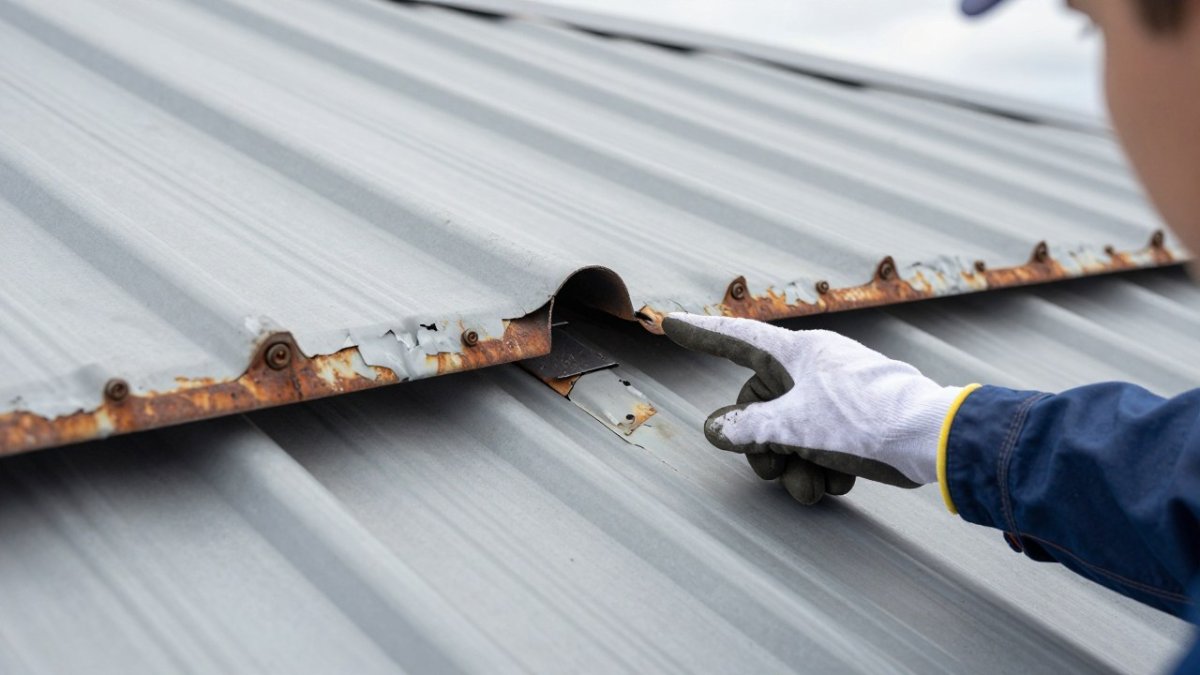
The signs of metal roof corrosion worth acting on: rust bleeding around fixings, chalky or flaking coating, sheet edges that crumble under a thumb, and brown staining running down the roof pitch. Surface rust on a sound sheet is typically a repair, while rust that has thinned the sheet usually means replacing that section.
Mistake 3: Choosing Repair or Replacement on Price Alone
The cheapest quote is a repair. The cheapest long-term outcome is sometimes a re-roof.
Repair makes sense when the roof is structurally sound, the pitch is correct, and the damage is isolated, a single failed flashing, a handful of corroded fasteners, one penetration that has lost its seal.
Replacement or re-sheeting wins when the damage is systemic rather than local. The signals to look for:
- Corrosion across multiple sheets. Rust that has thinned the steel in several places, not just at one edge, usually means the coating has failed over a wide area. Patching each spot buys time but the next spot is already forming.
- Repeat repairs in the same area. If the same section has been repaired twice, the underlying cause, often a low-pitch or ponding issue, has not been addressed. A third patch is money spent twice.
- Under-pitched or ponding roof. A roof that holds water after rain will keep finding new ways through. Re-sheeting to a correct pitch or profile is the durable fix.
- Age and remaining life. A metal roof near the end of its serviceable life will absorb repair money faster than a younger roof. Ask the roofer to estimate remaining life, not just the cost of the next repair.
- Widespread fastener failure. When fasteners are failing across the roof rather than in one run, re-sheeting with new fasteners is often more economical than replacing them piecemeal.
A useful way to frame the decision is to ask what the repair buys. A repair that reliably buys five or more years on a sound roof is good value.
Ask any roofer to explain why their option is right, not just how much it costs. A good answer will reference the condition of the sheets, the pitch, the pattern of previous repairs and the expected remaining life.
For a realistic sense of how restoration compares with replacement, our 2026 metal roof restoration cost guide for Melbourne breaks down what drives the numbers, and our guide to storm damage roof repair in Melbourne covers how insurers treat damage that is clearly storm-related rather than age-related.
Watch out: a roofer who recommends replacement without inspecting the roof from above, or who recommends repair without explaining what happens when the next section fails, is guessing rather than assessing.
The article sets out when a targeted repair is the right call and when the damage points to replacement instead.
| Decision | When it applies | Why |
|---|---|---|
| Repair | Roof structurally sound, pitch correct, damage isolated | Targeted repair restores the roof and money is well spent |
| Replacement or re-sheeting | Corrosion across multiple sheets | Coating has failed over a wide area |
| Replacement or re-sheeting | Repeat repairs in the same area | Underlying cause, often low pitch or ponding, not addressed |
| Replacement or re-sheeting | Under-pitched or ponding roof | Re-sheeting to correct pitch or profile is the durable fix |
| Replacement or re-sheeting | Roof near end of serviceable life | Older roof absorbs repair money faster |
| Replacement or re-sheeting | Widespread fastener failure | Re-sheeting with new fasteners often more economical |
Mistake 4: Ignoring the Cost of Roof Repairs per Square Metre Until It’s Too Late
The cost of roof repairs per square metre is a number many homeowners ask about first. Repair costs can vary considerably between roofs of identical area once access, pitch, material and the extent of sheet replacement are accounted for.
The main cost drivers on a metal roof are:
- Access and safety. A single-storey roof with clear ladder access is quick to reach. A double-storey roof, a steep pitch, a tiled or glazed area beneath the work, or a roof with no safe anchor point adds labour and sometimes scaffolding or a harness system. Access can be one of the largest single variables in a repair quote.
- Roof pitch and profile. Low-pitch roofs hold water and debris longer, so repairs often involve more than the visible damage. Corrugated and trimdek profiles handle differently from standing seam, and a roofer who does not carry the matching profile may need to order sheet.
- Material and finish matching. A Colorbond repair needs a sheet in the same profile and a close colour match, or the repair will be visible from the street. Older or discontinued colours can force a larger re-sheet of a full plane so the finish stays consistent.
- Extent of the repair. Sealing one penetration, replacing one flashing and re-sheeting a full plane are three different jobs with three different labour and material profiles. The per-square-metre figure only becomes meaningful once the scope is fixed.
- Disposal and make-good. Old sheet, fasteners and sealant have to be removed and disposed of, and insulation or ceiling lining disturbed by the leak may need replacing.
A common pattern is for a straightforward flashing or penetration repair on an accessible single-storey roof to sit at the lower end of the range, while a repair that involves re-sheeting a plane on a double-storey home with restricted access sits at the upper end.
For a realistic sense of how restoration compares with replacement, our 2026 metal roof restoration cost guide for Melbourne breaks down what drives the numbers.
Watch out: a quote that is dramatically cheaper than the others usually omits access, disposal or make-good, and those costs reappear later as variations.
Mistake 5: Hiring an Unlicensed Operator With No Guarantee
A cheap cash job with no paperwork is expensive the moment something fails. In Victoria, domestic building work above a set value must be done by a registered building practitioner, and the Victorian Building Authority lets you check a registration in minutes. Ask for the registration number and verify it yourself.
Then read the guarantee. A 10-year workmanship guarantee should be in writing and specific about what it covers. Top Glaze provides a 10-year workmanship guarantee on completed work, backed by fully licensed and insured professionals. Before you sign anything, our guide to hiring a licensed roofer in Melbourne sets out exactly what to verify.
Watch out: an operator who cannot produce a registration number or a certificate of currency for insurance is not insured, and you carry the risk.
Mistake 6: Letting Storm Damage and Blocked Gutters Sit Through Winter
Storm damage is rarely a dramatic hole. More often it is a lifted flashing, a dislodged sheet, or a gutter packed with leaf litter that backs water up under the roof edge.
After any major storm, check gutters and downpipes for blockages, look for lifted or dented sheets, and note any new ceiling stains. If you are unsure, our guide to storm damage roof repair in Melbourne covers safe assessment and how to document the damage for an insurance claim. Photograph everything before repairs start, because insurers will ask.
Requesting a Free Metal Roof Repair Inspection
A proper inspection answers three questions: what is actually wrong, whether it needs repair or replacement, and what it will cost. Top Glaze offers a $0 call-out fee inspection, with no obligation to proceed.
We have 38 years of experience, award-winning services, and a 10-year workmanship guarantee on completed work. If you want a straight answer on your metal roof repair, book an inspection.
Your roof will not fix itself, and the longer a leak or a rusted sheet sits, the more of the structure it takes with it. Get a licensed, insured team to look at it properly before winter does the rest. Get started with Top Glaze and protect your home with expert workmanship and a 10-year guarantee.
Frequently Asked Questions
How much does it cost to repair a metal roof?
Pricing depends on the job: sheet replacement, flashing repairs and leak detection all carry different labour and material costs, and access height affects the quote. Pricing depends on the roof, so the reliable way to get a real figure is to request a quote from Top Glaze or visit the Top Glaze website for current details. Ask for the quote broken down by task so you can see exactly what you are paying for.
How do I know if my metal roof needs replacing or repairing?
Patch repairs suit isolated damage such as a few corroded sheets, a failed flashing or a single leak. Replacement makes more sense when corrosion is widespread, sheets are under-pitched and holding water, or repairs keep recurring in the same spot. A professional assessment should check sheet thickness, fixing condition and drainage before recommending either path.
Can you patch a leaking metal roof?
Yes, in the right circumstances. A patch works when the leak traces to a single penetration, a failed seal or one damaged sheet, and the surrounding metal is still sound. It is a short-term fix if corrosion has spread underneath, because new sealant will not bond to flaking or rusted steel. Proper metal roof leak detection first tells you whether a patch will hold or whether sheet replacement is the honest answer.
Do I need a licensed professional for metal roof repairs?
Metal roofing work should be carried out by licensed and insured tradespeople. Beyond compliance, a licensed roofer can assess corrosion, match Colorbond colours and profiles correctly, and back the work with a guarantee. Ask for the licence number and insurance certificate before work begins. Top Glaze offers a 10-year workmanship guarantee and a $0 call-out fee on inspections, so you can verify credentials before committing to anything.


