

Have you ever wondered what’s actually standing between your plaster ceiling and a fierce Melbourne storm when a roof tile cracks or wind drives rain upward? While your tiles do the heavy lifting, high-quality sarking provides the essential backup that prevents a small leak from becoming a major structural repair. It’s the silent protector of your home’s integrity, yet many people don’t realise it’s even there until it needs replacing.
We know that managing moisture buildup and rising energy costs can be a constant source of anxiety for Melbourne families. In this guide, you will discover how this reflective foil layer protects your home from the elements, provides a critical shield against bushfire embers, and ensures you stay compliant with the latest Victorian building standards. We’ll explain why this “second skin” is the smartest investment you can make for a drier, more energy-efficient home, and how we assess it during a professional roof restoration.
Key Takeaways
- Understand why a pliable membrane acts as a vital “second skin” to protect your home’s structural integrity from moisture and dust.
- Discover how quality sarking manages condensation and wind-driven rain during harsh Melbourne winters and coastal storms.
- Learn about mandatory Victorian requirements for bushfire ember protection and how to ensure your roof remains compliant.
- Find out why a professional roof restoration is the most practical and cost-effective time to upgrade your home’s weatherproofing.
- Identify the critical signs of material failure, such as flaking or sagging, that suggest your roof cavity is at risk.
Understanding Roof Sarking: The Second Skin for Your Home
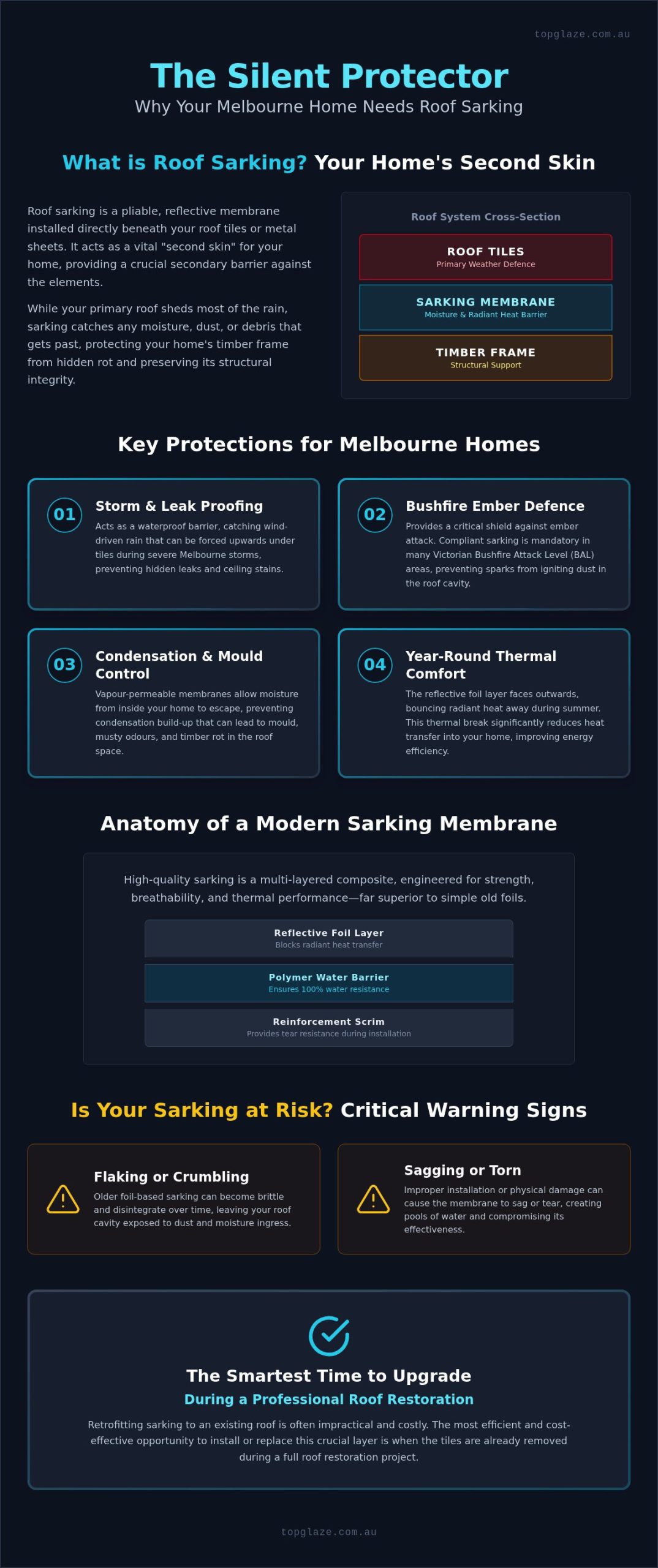
In the Australian building industry, Sarking refers specifically to a pliable, reflective membrane installed directly beneath your roof’s primary material, whether that’s concrete tiles or metal sheets. We often describe it as a “second skin” because it provides a critical layer of protection that your external roof alone cannot always guarantee. While tiles and metal are designed to shed the bulk of Melbourne’s rain, they aren’t always 100% airtight or watertight during extreme weather events. This is where a high-quality membrane proves its worth.
Think of sarking as your home’s last line of defence. It acts as a weather-proof barrier that catches any moisture, dust, or debris that manages to bypass your primary roofing. Beyond just stopping leaks, it plays a vital role in preserving the structural integrity of your timber frame. By keeping the roof cavity dry, you prevent the slow, hidden rot that can compromise rafters and ceiling joists over decades. Traditionally, this was a simple layer of blue or silver foil, but modern technology has introduced breathable membranes that offer far superior performance for our unique Victorian climate.
How Sarking Works Beneath Your Tiles or Metal
The installation process relies on a precise “lapping” technique. We overlap the sheets so that any water penetrating the outer roof flows down the surface of the membrane and directly into your gutters. It effectively creates a secondary drainage plane. Additionally, the reflective side of the material is designed to face outward. This allows it to bounce radiant heat away from your roof cavity, which is a game-changer during those scorching 40-degree Melbourne afternoons. By maintaining a small air gap between the membrane and the roof material, we create a thermal break that significantly reduces the heat transfer into your living spaces.
The Components of a High-Quality Membrane
Modern materials are far more sophisticated than the basic foils of the past. A high-quality installation typically involves multiple layers, including reflective foil for heat management, polymer layers for water resistance, and a reinforcement scrim that prevents tearing during installation or high winds. We generally categorise these into heavy-duty and light-duty options. For most Melbourne residential restorations, we recommend a heavy-duty, vapour-permeable membrane. Breathability is essential here; it allows moisture from inside your home to escape while preventing external water from entering. This balance is the best way to avoid the dampness and mould issues often found in older, poorly ventilated Melbourne homes.
Why Melbourne Homeowners Need Quality Roof Sarking
Melbourne’s climate presents a unique set of challenges that standard roofing materials can’t always handle alone. From the biting winds of the Bass Strait to the intense summer heatwaves, your home requires a layer of protection that goes beyond the surface. While we discussed how the membrane acts as a second skin, its true value is proven during our city’s most volatile weather events. It isn’t just an optional extra; it’s a fundamental requirement for maintaining a healthy, durable home in Victoria.
During heavy storms, Melbourne often experiences “wind-driven rain.” This occurs when high-velocity winds force water upwards under the laps of your tiles or through small gaps in ridge capping. Without sarking, this water enters your roof cavity directly, often leading to ceiling stains that only appear hours after the rain has stopped. By catching and redirecting this moisture into the gutters, you prevent the kind of hidden damage that usually results in expensive emergency repairs.
For those living in peri-urban areas or the Melbourne fringe, fire safety is a non-negotiable priority. Under current Victorian building standards, homes located in Bushfire Attack Level (BAL) areas classified from 12.5 to 40 must have a membrane with a flammability index of 5 or less. This acts as a secondary barrier against ember attack. It prevents stray sparks from igniting the dust and debris that naturally accumulates in roof spaces over time, providing an extra layer of security when it matters most.
Moisture Control and Mould Prevention
Melbourne winters are notorious for high humidity and low temperatures. When warm air from your heaters rises into the roof space and hits the cold underside of your tiles or metal sheets, it creates condensation. This moisture often drips onto your ceiling insulation, dampening the batts and significantly reducing their R-value. Over time, this leads to the persistent “musty” smells common in older Melbourne homes and can cause dry rot in structural roof timbers. A vapour-permeable membrane allows this internal moisture to escape while keeping the external elements out.
Thermal Performance in Extreme Heat
On a 40-degree Melbourne day, the temperature inside a roof cavity without a radiant barrier can soar well above the outside ambient temperature. High-quality reflective barriers are designed to reflect up to 95% of this radiant heat away from your living spaces. This significantly reduces the workload on your evaporative cooling or air conditioning systems. By creating a more stable internal temperature, you’re not just improving your family’s comfort; you’re actively lowering your quarterly energy bills. A quick check of your roof’s protective layers is a standard part of our roof restoration process, giving you peace of mind before the next season hits.
Retrofitting and Repair: Can You Add Sarking to an Existing Roof?
Many homeowners in Melbourne’s established suburbs find themselves in a difficult position. Their homes were often built during an era when sarking was either optional or installed using materials that haven’t stood the test of time. If you’ve discovered that your roof cavity is missing this protective layer, you might be wondering if it’s possible to add it now. The short answer is yes, but the process is more involved than simply stapling foil to the rafters from the inside.
To function correctly as a secondary drainage plane, the membrane must be installed over the rafters and beneath the tile battens or metal sheets. This allows any moisture to run down into the gutters. Because of this structural requirement, retrofitting usually involves the temporary removal of your roofing material. While this sounds like a major undertaking, it’s a routine procedure during a professional roof restoration or replacement. Attempting to install “internal” foil from within the attic space is often a wasted effort; it might provide some thermal reflection, but it cannot manage water ingress or protect your timber from rot.
Identifying Failed Sarking in Older Homes
If your home is more than 20 years old, your existing protection may already be failing. One of the most common signs we see during inspections is “silver dust” coating the items stored in your roof space. This is actually the aluminium layer of older bitumen-based products oxidising and flaking away. As these materials age, they become incredibly brittle. They often tear at the fixing points or sag significantly between the rafters. In some cases, we find that brittle, perished membrane has actually slipped down and blocked the eave ventilation. This traps heat and moisture, which accelerates the deterioration of your roof’s structural timbers.
The Restoration Window: A Strategic Upgrade
At Top Glaze Roofing Systems, we believe the most cost-effective time to address these issues is during a planned restoration. When we perform a “lift and re-lay” on a tiled roof, we remove the tiles and old battens, install a modern, vapour-permeable membrane, and then install new treated timber battens. This is the ideal window to upgrade your home’s weatherproofing without the full cost of a total replacement. By incorporating this into a project backed by our 10-year warranty, you’re ensuring that your home’s internal structure remains bone-dry and energy-efficient for the long term. It’s a strategic investment that removes the anxiety of hidden leaks and provides the peace of mind that your “second skin” is performing exactly as it should.
Comparing Sarking for Tiled vs. Metal Roofing Systems
While the fundamental goal of weatherproofing remains constant, the way we apply sarking changes based on whether your Melbourne home has a tiled or metal roof. Each material interacts with the environment differently, meaning the secondary barrier must be tailored to address specific structural risks. Understanding these nuances is key to ensuring your roof’s “second skin” lasts as long as the primary material above it.
The installation methods also vary significantly between the two systems. For tiled roofs, the membrane is usually installed with a calculated “drape” between the rafters. This creates a natural valley for water to flow. In contrast, metal roof installations often require the material to be pulled taut or integrated with a specialized blanket to manage both temperature and sound. These technical differences are why we always conduct a thorough site inspection before recommending a specific product for your home.
Specific Needs for Terracotta and Concrete Tiles
Tiled roofs are composed of hundreds of individual units that naturally shift as your house settles over its 30+ year lifespan. Because tiles are not a continuous surface, they are susceptible to “capillary action,” where water is literally sucked upward between overlapping tiles during heavy rain. In these systems, the drape we create between the rafters is essential. It prevents water from pooling against the timber battens, which could otherwise lead to rot. For heavy terracotta or concrete tiles, the membrane must also be robust enough to withstand the weight and minor movements of the roof without tearing at the fixing points or losing its tension over time.
Metal Roofing (Colorbond) and Condensation
Metal roofs, such as Colorbond, face a completely different challenge known as “underside condensation.” Because metal is an excellent thermal conductor, it cools down rapidly at night. When the warm, moist air from your home hits that cold metal surface, it “sweats,” creating droplets that can rain down onto your ceiling. To combat this, we often use an “anti-con” blanket, which combines a reflective foil face with a thin insulation layer. This prevents the warm air from reaching the cold metal, effectively stopping the “sweating” process and protecting the underside of your metal sheets from corrosion.
You may also notice that modern sarking for metal roofs often features a blue or green anti-glare coating. This is a vital safety feature designed to protect installers from the blinding reflection of the sun off the foil during the installation process. By choosing the right material for your specific roof type, you ensure your home stays quiet, dry, and structurally sound. If you aren’t sure which system is currently protecting your home, we can provide a professional assessment as part of our roof restoration service.
Why Choose Top Glaze Roofing Systems for Your Roof and Sarking Needs
Selecting a contractor to manage your roof’s structural health is a significant decision. With over 30 years of experience specifically within the Melbourne metropolitan area, Top Glaze Roofing Systems has built a reputation as a stable, reliable guardian of local homes. We don’t just look at the surface; we understand the complex relationship between your tiles, your timber, and your sarking. Our long-standing presence in the community means we’ve seen the results of every Melbourne weather pattern, from the hailstorms of the east to the coastal winds of the bayside.
Every project we undertake is driven by a commitment to excellence and longevity. We provide a comprehensive 10-year warranty on our workmanship, ensuring that your investment is protected well into the future. Because we’re fully licensed and deeply experienced in both classic terracotta and modern metal roofing systems, you can move forward with the calm certainty that your home is in expert hands. We believe in providing solutions that remove homeowner anxiety rather than adding to it.
The Top Glaze Roofing Systems Inspection Process
Our assessment goes far beyond a quick glance from the street. We perform a detailed analysis of your roof cavity to identify hidden issues that others might miss, such as micro-cracks in tiles or early signs of timber rot. We provide transparent reporting on the condition of your existing sarking, advising whether a targeted repair or a full upgrade is the most responsible path forward. This includes specific guidance on the correct material grades for your suburb’s specific Bushfire Attack Level (BAL) rating, ensuring your home meets all current Victorian safety standards.
A Complete Restoration Solution
A roof is a holistic system, which is why we offer an integrated approach to restoration. We often coordinate the installation of new protective membranes with guttering, fascia, and leaf guard replacements to ensure total water management. Our team is meticulous about site safety and we take every precaution to keep your home perfectly dry during the entire installation process. We value long-term relationships over quick wins, which is why we prioritise transparency and clear communication from the first inspection to the final clean-up.
Ready to protect your home? Book a free roof inspection with Top Glaze Roofing Systems today.
Secure Your Home Against the Melbourne Elements
Your roof is more than just a collection of tiles or metal sheets; it’s a complete system designed to keep your family safe and dry. By ensuring your sarking is in top condition, you’re investing in a drier, more energy-efficient home that can withstand everything from Bass Strait storms to extreme summer heatwaves. This secondary barrier is your best defence against hidden moisture buildup and a critical tool for meeting Victorian bushfire safety standards.
Top Glaze Roofing Systems has been Melbourne-owned and operated since 1987. As licensed and insured roofing specialists, we have spent over three decades perfecting our craft across the local community. We stand by the quality of our workmanship with a 10-year warranty on all residential projects, providing the long-term stability you expect from a local veteran. Don’t wait for a damp patch on the ceiling to reveal a failure in your home’s protection.
Take the first step toward total peace of mind for your property. Get a Free Professional Roof Assessment and Sarking Check today and ensure your home remains a sanctuary for years to come.
Frequently Asked Questions
Is roof sarking mandatory in Victoria?
Yes, sarking is mandatory in Victoria for homes located in Bushfire Attack Level (BAL) areas classified from 12.5 to 40. Additionally, the Building Code of Australia requires it for tiled residential roofs with rafter lengths exceeding 6 metres, or 4.5 metres if the roof pitch is less than 20 degrees. These regulations ensure your home meets modern safety and moisture management standards. We always verify these requirements during our initial site assessments.
Can I install sarking from inside my attic?
No, you cannot effectively install sarking from inside your attic if you want it to manage water ingress. To work as a secondary drainage plane, the material must sit over the rafters and beneath the tile battens or metal sheets. This allows water to run down the surface and into the gutters. Stapling foil to the inside of your rafters might provide minor thermal benefits, but it won’t protect your timber from rot or leaks.
Does roof sarking help with noise reduction?
Yes, sarking contributes to noise reduction, particularly when we install it on metal roofs. When we use a specialised “anti-con” blanket, the thin layer of insulation bonded to the foil face dampens the sound of heavy rain and hail. While it isn’t a replacement for bulk acoustic insulation, it significantly reduces the “drumming” effect often associated with Colorbond or corrugated iron roofs during a typical Melbourne downpour.
What is the difference between sarking and insulation batts?
Sarking and insulation batts serve two different purposes. Sarking is a thin, reflective membrane that acts as a weather barrier and radiant heat shield. Insulation batts are thick “bulk” materials designed to slow down the transfer of heat through conduction. For the best result in the Victorian climate, you generally need both to meet the energy efficiency requirements of the National Construction Code. They work together to keep your home comfortable.
How long does roof sarking typically last?
High-quality modern membranes typically last between 20 and 30 years. However, older bitumen-based products used in many Melbourne homes built before the 1990s often fail much sooner. These older materials become brittle and flake away, leaving your roof cavity vulnerable. We recommend a professional check every 10 years to ensure the material hasn’t sagged, torn, or started to oxidise into “silver dust” that coats your ceiling space.
Can I repair small tears in my existing roof sarking?
Yes, you can repair small tears or punctures in your existing membrane using specialised reinforced foil tapes. It’s important to use high-tack tapes designed specifically for roofing environments rather than standard hardware tape. However, if the material is flaking or brittle due to age, taping is only a temporary fix. In these cases, we usually recommend replacing the affected runs during a professional roof restoration to ensure long-term protection.
How much does it cost to add sarking to an existing roof?
The material cost for sarking is approximately $8 to $10 per square metre. While the material itself is affordable, the labour involves removing and re-installing your roof tiles or metal sheets. Because of this, adding it to an existing roof is most cost-effective when performed as part of a larger re-roofing or restoration project. This avoids the expense of paying for the same labour twice while upgrading your home’s integrity.
Does sarking prevent roof leaks entirely?
No, sarking is not a substitute for a well-maintained primary roof. It’s designed as a secondary barrier to catch minor seepage, wind-driven rain, or moisture from cracked tiles. If your roof has major structural issues or significant tile damage, water will eventually find a way through. Think of it as a safety net that protects your ceiling and insulation while you arrange for professional roof repairs to fix the root cause.


