
The cheapest roof restoration quote is often the most expensive mistake a Melbourne homeowner can make. When you request a roof restoration quote melbourne residents often find themselves staring at three different prices that don’t seem to talk the same language. It’s frustrating when one contractor mentions “bedding and pointing” while another just promises a quick spray that might peel in two years. You’re right to feel cautious. Selecting the lowest bidder often leads to “cowboys” who skip the essential structural work your home needs to survive the Victorian climate.
We understand that your home is your biggest investment, and you want it protected without being overcharged. In this guide, you’ll learn how to evaluate a professional quote and identify the true value behind the numbers for your Melbourne property. We’ll clarify those confusing technical terms and explain how the NCC 2026 standards, including the 7-star NatHERS rating and condensation management, impact your restoration. You’ll gain the confidence to choose a contractor who offers a long-term warranty and a roof that’s both beautiful and structurally sound.
In this guide, you will discover:
- The critical elements of a professional quote, including structural inspections of bedding, pointing, and anti-fungal sterilisation.
- How variables like roof pitch, height, and material (terracotta vs. cement) influence labour and material costs for your Melbourne property.
- Common red flags to watch for, including “roof cowboys” and the risks of skipping essential repairs for a cheap, superficial spray job.
- The impact of local environmental factors, such as Peninsula salt spray, and the latest NCC 2026 building standards on your project.
- The best way to evaluate a roof restoration quote melbourne to ensure you are investing in long-term structural health rather than a temporary cosmetic fix.
The Anatomy of a Professional Roof Restoration Quote
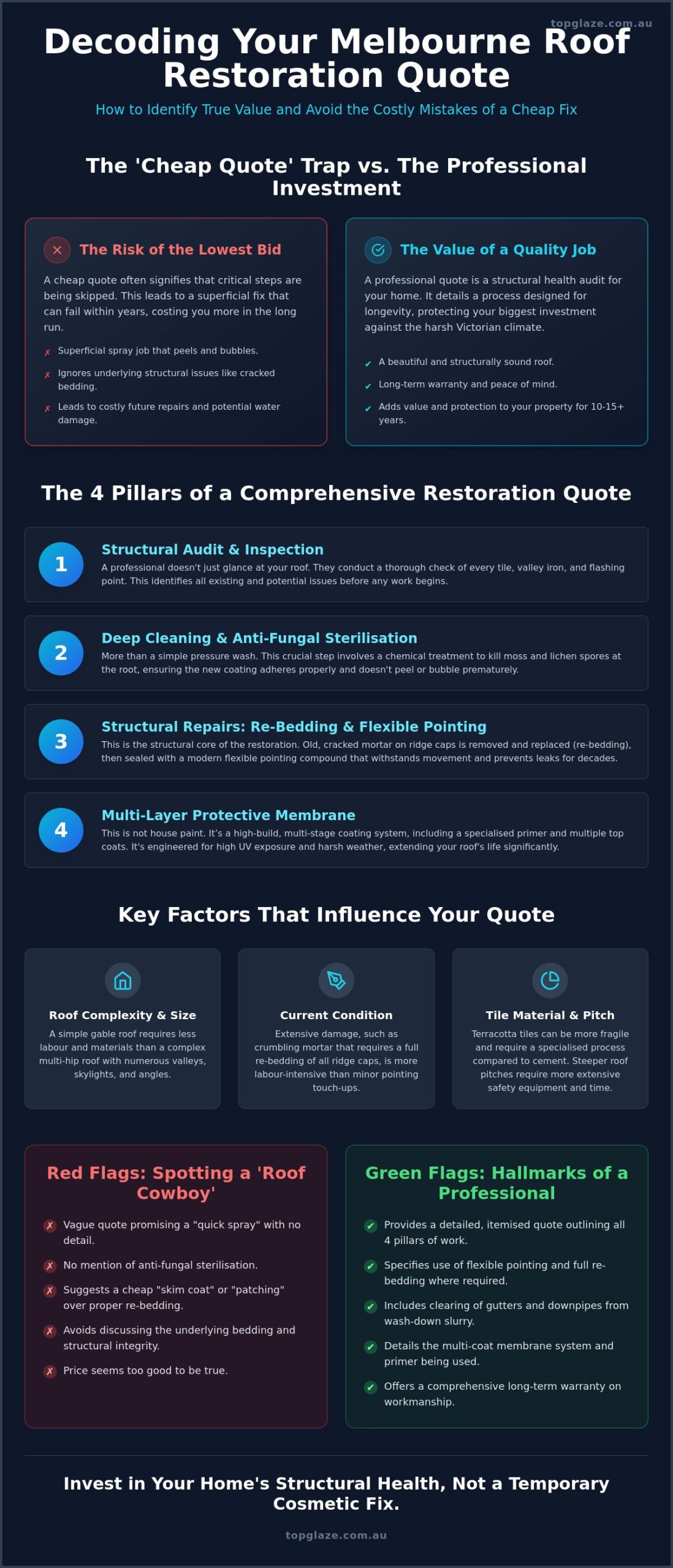
A high quality roof restoration quote melbourne residents can rely on is far more than a simple price tag. It serves as a structural health audit for your home. When you receive a professional assessment, it should break down the process into clear, logical stages that address both the aesthetic and the underlying integrity of the structure. A veteran contractor doesn’t just look at the surface; they examine the tiles, the condition of the sarking, and the stability of the timber battens. This level of detail ensures that you aren’t just paying for a cosmetic “quick fix” that fails at the first sign of a Victorian storm.
A comprehensive quote typically includes four primary pillars of service:
- Structural Audit: A thorough check of every tile, valley iron, and flashing point.
- Sterilisation: Killing the root systems of organic growth to ensure a clean bond.
- Structural Repairs: Re-bedding and flexible pointing to secure the ridge caps.
- Protective Coating: A multi-stage membrane system engineered for high UV exposure.
Cleaning and Sterilisation: More Than Just Water
Many homeowners assume a pressure wash is all that’s needed to prepare a roof. This is a common misconception that leads to premature coating failure. A professional wash must include a specialised anti-fungal sterilisation treatment. Lichen and moss are not just surface stains; they are living organisms that bore into the tile, increasing porosity and holding moisture against the roof. If these spores aren’t chemically neutralised, they will continue to grow under your new coating, causing it to bubble and peel within a few seasons. A proper quote will also specify that gutters and downpipes are cleared of all slurry and debris during the wash-down process to prevent blockages.
Bedding and Pointing: The Structural Core
The ridge caps are the most common source of leaks in Melbourne homes. Traditional mortar bedding is rigid and prone to cracking as your house naturally settles or shifts with the seasons. A professional roofer will quote for full re-bedding where necessary, followed by a layer of modern flexible pointing. Unlike old cement, flexible pointing is designed to expand and contract without breaking the seal. This creates a waterproof barrier that keeps your roof secure for decades. If your quote only mentions “patching” or “re-pointing” without checking the underlying bedding, you’re likely looking at a temporary patch rather than a long-term solution. Identifying when old tiles are beyond simple repair is a skill that only comes with years of local experience on the tools.
Finally, the protective membrane system is applied. This isn’t house paint. It’s a high-build coating system that includes a primer specifically matched to your tile type, followed by multiple coats of a weather-shield membrane. This system is what provides the 10 to 15 years of extended lifespan that makes restoration such a cost-effective alternative to full replacement.
Why Roof Restoration Prices Vary Across Melbourne
Price variations across the city aren’t accidental. When you compare a roof restoration quote melbourne contractors provide, you’ll notice the numbers fluctuate based on the specific DNA of your property. It’s a common mistake to assume two houses with the same floor plan will cost the same to restore. In reality, the complexity of the roofline, the height of the gutters, and the linear metres of ridge capping dictate the final investment. A simple gable roof is far easier to navigate than a complex multi-hip roof with several valleys and skylights. Each additional angle requires more labour, more safety equipment, and more materials.
The current condition of your ridge capping and bedding is perhaps the biggest variable. If the mortar is crumbling or has completely detached, a full re-bedding is necessary. This process is labour-intensive and involves removing the old cement before laying fresh mortar. While some operators might suggest a quick “skim coat” to keep costs down, this is a short-term fix that won’t stand up to Melbourne’s unpredictable weather. For a truly accurate picture of your home’s needs, it’s best to book a professional roof assessment to see exactly what’s happening above the gutter line.
Terracotta vs. Cement Tile Requirements
Terracotta tiles, found frequently in Melbourne’s older, established suburbs, present unique challenges. They’re often more fragile and require a specialised cleaning process to avoid damage. Because terracotta is naturally non-porous when glazed, it requires a specific “high-grip” primer to ensure the new membrane doesn’t peel. Cement tiles, on the other hand, become highly porous as they age. They act like a sponge, soaking up the first coat of paint. This means they often require a high-build primer to seal the surface before the colour coats are applied. Choosing the wrong primer for the material type is a primary cause of restoration failure.
Site Access and Safety Requirements
Safety isn’t an optional extra; it’s a legal requirement. The Victorian Building Authority (VBA) and WorkSafe Victoria have strict standards for working at heights. If your home is two storeys or has a particularly steep pitch, the quote must include provisions for perimeter guard rails or scaffolding. While “cheap” quotes often skip these essential safety measures to lower their price, they leave the homeowner vulnerable to liability if an accident occurs. You can find more information on your rights and builder obligations through Consumer Affairs Victoria. A reputable specialist will always prioritise a safe worksite, ensuring the job is done correctly without cutting corners on protection.
Spotting the ‘Roof Cowboy’: Red Flags in Cheap Quotes
A suspiciously low roof restoration quote melbourne homeowners receive is often a warning sign rather than a bargain. Door-to-door operators are a classic red flag. They often use high-pressure tactics, offering a “special today only” price because they claim to have left-over materials from a job nearby. A seasoned professional doesn’t work this way. We provide detailed, written assessments and give you the space to make an informed decision without an artificial clock ticking. If a price seems too good to be true, it’s usually because the contractor is planning to cut corners where you can’t see them.
The most dangerous shortcut is the “Wash and Spray” trap. As we noted in the previous sections, a roof’s health depends on its structural integrity. Cowboys skip the tedious work of grinding out old mortar and re-bedding ridge caps. Instead, they simply pressure wash the tiles and spray a thin layer of paint over the top. Without the flexible pointing to secure the caps, the new paint will begin to flake and peel as the ridge caps shift underneath. You’re left with a roof that looks worse than before within two years, and you’ll likely have to pay a professional to strip it all back and do it properly.
The Problem with Thin Coatings
Thin coatings are a disaster under the harsh Victorian sun. A professional membrane system must be applied at a specific thickness to provide genuine UV protection and waterproofing. Some operators water down their products or apply only a single coat to save on material costs. In the peak of summer, these thin layers break down and lose their elasticity. A quality restoration requires a multi-stage system: a high-build primer followed by two thick coats of UV-stable membrane. This creates a durable, weather-tight shield that stays flexible as your home expands and contracts. Without that thickness, the coating is purely cosmetic and offers no protection against the elements.
The Value of a Long-Term Warranty
A 10-year warranty is the industry standard, but it’s only as good as the company behind it. Many fly-by-night operators change their business names every few years to avoid liability and warranty claims. A genuine, transferable warranty should cover both labour and materials. This means you are protected against both product failure and poor workmanship. Before you commit, it is vital to verify the license and insurance of your contractor. The Victorian Building Authority offers essential guidance on checking practitioner registration and compliance. Choosing a specialist with decades of local experience ensures that your warranty is a promise that will actually be kept, providing the peace of mind you deserve.
Local Factors: Preparing Your Melbourne Home for Restoration
Melbourne’s weather is famously fickle. When you request a roof restoration quote melbourne specialists provide, it must reflect the logistical reality of working in a city that can experience four seasons in a single afternoon. A local expert doesn’t just look at your tiles; they look at your postcode and the surrounding environment. Whether you are dealing with the harsh salt air of the Mornington Peninsula or the heavy leaf fall in the Dandenong Ranges, your restoration plan needs to be tailored to these specific stressors. Local council regulations for heritage-listed roofs in suburbs like Carlton or Camberwell also play a role, as certain colours or tile types may be mandated to preserve the streetscape. Managing these variables requires more than just technical skill; it requires local intuition. We’ve spent decades watching the clouds roll over Port Phillip Bay, and we know that a successful restoration depends on timing as much as technique.
Seasonal Timing and Weather Management
Spring and autumn are the goldilocks seasons for roofing in Victoria. During these months, the ambient temperature is usually ideal for the protective membrane to cure correctly. If it’s too cold, the coating won’t bond; if it’s a 40-degree scorcher, the product can dry too quickly, leading to “flash drying” and potential cracking. Professional teams monitor Bureau of Meteorology radar feeds constantly. We manage rain delays by ensuring the roof is always “dried in” and weather-tight before we leave the site for the day. This prevents moisture from entering your roof cavity during the transition between cleaning and coating. Summer also brings the challenge of extreme thermal expansion. As your roof heats up, the materials expand significantly. This is why we insist on the flexible pointing mentioned earlier, as it moves with the tiles rather than cracking under the pressure of a Melbourne heatwave.
Coastal vs. Inland Roofing Challenges
If you live within five kilometres of the coast, your roof faces a constant barrage of salt-laden winds. This accelerated corrosion affects valley irons, flashings, and even the fasteners holding your gutters in place. For homes in coastal areas, we often recommend extra corrosion protection or specialised coatings that can withstand the high-salinity environment. Conversely, for inland homes in heavily treed suburbs like Eltham or Berwick, the primary threat is organic debris. Debris trapped in valleys or behind chimneys holds moisture against the tiles, leading to the moss and lichen growth we discussed in section one. Installing a high-quality leaf guard system is often the most effective way to extend the life of your restoration in these leafy areas. It keeps the waterways clear and prevents the rot that can quietly destroy your fascia boards and gutters.
Securing Your Investment with a Licensed Specialist
Choosing a local specialist with over 30 years of experience provides a level of peace of mind that a cheaper, fly-by-night operator simply cannot match. When you evaluate a roof restoration quote melbourne homeowners often find that the most reputable companies are those with deep roots in the community. At Top Glaze, our commitment to licensed workmanship and premium materials is built on decades of successful projects across Victoria. We’ve seen every type of roof failure imaginable, and we know exactly what it takes to make a home weather-tight for the next generation. A professional restoration does more than just stop leaks. It transforms the appearance of your home, adding significant market value and curb appeal that pays dividends if you ever decide to sell.
A quality restoration is an investment in the structural longevity of your property. By addressing the issues we’ve covered in this guide, such as organic growth and crumbling ridge capping, you are preventing expensive internal water damage. We take pride in being a reliable fixture in the local industry. Our reputation is built on long-term relationships rather than quick wins, which is why we focus on delivering a result that looks as good in ten years as it does on the day we finish the project.
The Top Glaze Difference: 10-Year Peace of Mind
Our approach prioritises structural integrity over superficial finishes. As we discussed in earlier sections, a beautiful coating is useless if the bedding and pointing underneath are failing. We provide a comprehensive 10-year warranty on residential projects, covering both our high-grade materials and our expert labour. Whether you are located in the heart of the city or down on the Mornington Peninsula, our teams bring the same level of seasoned expertise to every job. We don’t believe in shortcuts; we believe in doing the job once and doing it right. This commitment ensures your home remains a safe haven against the unpredictable Victorian climate.
Next Steps: Getting Your No-Obligation Assessment
Moving from a quote to a fully restored home should be a transparent and stress-free process. During a Top Glaze professional site inspection, we don’t just glance at the tiles from the driveway. We conduct a thorough audit of your home’s structural health to identify any hidden vulnerabilities. Your detailed quote will break down every stage of the process, from the initial anti-fungal sterilisation to the final protective membrane application. This transparency ensures you understand exactly where your investment is going and removes the anxiety often associated with home maintenance. Book your professional roof assessment with Top Glaze today to secure your home’s future with a team you can trust.
Protect Your Investment for the Long Term
A quality restoration is about more than just a fresh coat of paint. It’s a comprehensive process that secures the structural core of your home, from the ridge capping to the anti-fungal treatment. By understanding the variables that influence a roof restoration quote melbourne, you can avoid the risks of “cowboy” operators and choose a solution that stands up to the Victorian elements. The true value lies in the thorough preparation, the thickness of the UV-stable membrane, and the peace of mind that comes with a genuine warranty.
With over 30 years of local experience, our licensed and insured roofing specialists are dedicated to providing the stability and quality your property deserves. We focus on excellence and longevity, ensuring your roof remains a reliable guardian for your family. Get a transparent, professional roof restoration quote from Top Glaze today and benefit from our 10-year warranty on residential projects. We look forward to helping you restore your home’s beauty and structural integrity with the expert care it deserves.
Frequently Asked Questions
How much does a roof restoration quote typically cost in Melbourne?
A professional roof restoration quote melbourne residents receive should be provided as a no-obligation service at no cost to the homeowner. It involves a physical site visit where a specialist performs a structural audit of your tiles, bedding, and valley irons. You shouldn’t be charged for this assessment, as it is the standard practice for established local businesses to provide a transparent breakdown of costs before any work begins.
Is a roof restoration just a fancy name for painting the roof?
No, a restoration is a structural overhaul, whereas painting is purely a cosmetic exercise. While a “cowboy” operator might simply spray a thin layer of paint over dirty tiles, a professional restoration includes high-pressure cleaning, anti-fungal sterilisation, and essential repairs like re-bedding and flexible pointing. This process ensures the roof is structurally sound and weather-tight before a multi-stage protective membrane is applied.
Can you restore a terracotta tile roof, or should it be replaced?
Most terracotta roofs are excellent candidates for restoration provided the tiles haven’t become too brittle or porous. Because terracotta is a natural clay product, it requires a specialised cleaning process to remove deep-seated lichen and a high-grip primer to ensure the new coating adheres properly. If the tiles are crumbling or show signs of “shelling,” your specialist will advise if a replacement is the safer long-term path.
How long does a professional roof restoration actually take?
A standard residential restoration typically takes between 3 and 5 working days to complete. This timeframe allows our team to perform the cleaning, structural repairs, and the application of multiple coating layers with adequate drying time in between. We monitor the local weather closely, as we won’t apply coatings if rain is forecast, ensuring the integrity of the finish isn’t compromised by a sudden Melbourne downpour.
Do I need to be home while the roof restoration is being performed?
You don’t need to be home while the work is being carried out because all activity takes place on the exterior of your property. As long as our team has access to an external garden tap for our cleaning equipment and a power point, we can proceed with the project while you go about your daily routine. We’ll always provide a courtesy update on our progress at the end of each day.
Will a roof restoration fix the leaks in my ceiling?
Stopping leaks is a core objective of the restoration process. During the initial inspection, we identify the specific entry points, which are often cracked tiles, rusted valley irons, or failing ridge cap mortar. By replacing these damaged components and resealing the entire surface with a high-build membrane, we create a waterproof barrier that protects your home’s interior from future water damage.
How do I know if I need a restoration or a full roof replacement?
Restoration is usually the best choice for roofs that are structurally sound but showing signs of age like faded colour or cracked pointing. Replacement is generally only necessary if the underlying timber battens have rotted or if the tiles themselves have reached the end of their functional life and are breaking under their own weight. A professional assessment will determine which path offers the best value for your home.
What is the difference between bedding and pointing on a tile roof?
Bedding is the thick sand and cement mortar that physically holds the ridge caps in place on the roof. Pointing is the flexible layer applied over the edge of the bedding to create a decorative, waterproof seal. We use modern flexible pointing because it is designed to expand and contract with the house, preventing the cracks that typically lead to leaks in older Melbourne homes.


