

Roughly one in five Australian homes shelter beneath Colorbond steel, yet a 45-year warranty doesn’t mean your roof will sit untouched for four decades. If you’re asking how long do Colorbond roofs last in genuine Australian conditions, the honest answer depends far more on your local climate and ongoing care than the steel profile alone.
It’s completely natural to feel uncertain. Many homeowners struggle to separate manufacturer promises from on-the-roof reality, especially when comparing metal against traditional tiles or worrying about coastal salt spray, paint chalking, and premature corrosion under sheltered eaves. In this guide, you’ll discover the realistic lifespan of Colorbond roofing under our harsh sun, alongside practical strategies to help your sheets reach the 50-year mark without leaks.
We’ll examine the clear distinction between cosmetic finish wear and structural integrity, outline essential maintenance habits, and give you the confidence to decide whether your home needs routine care, professional restoration, or a complete replacement.
Key Takeaways
- When assessing how long do Colorbond roofs last, a properly installed roof generally delivers 40 to 70 years of reliable shelter depending on your microclimate.
- Choosing between standard steel and marine-grade Colorbond Ultra is essential for homes exposed to breaking surf, coastal breezes, or industrial fallout.
- Rain cleans open sheets naturally, but sheltered sections beneath eaves require routine freshwater rinsing to prevent trapped salts from triggering premature corrosion.
- Surface paint chalking or cosmetic fading indicates an ideal window for roof restoration rather than an immediate need for complete replacement.
The Realistic Lifespan: How Long Does Colorbond Last in Australia?
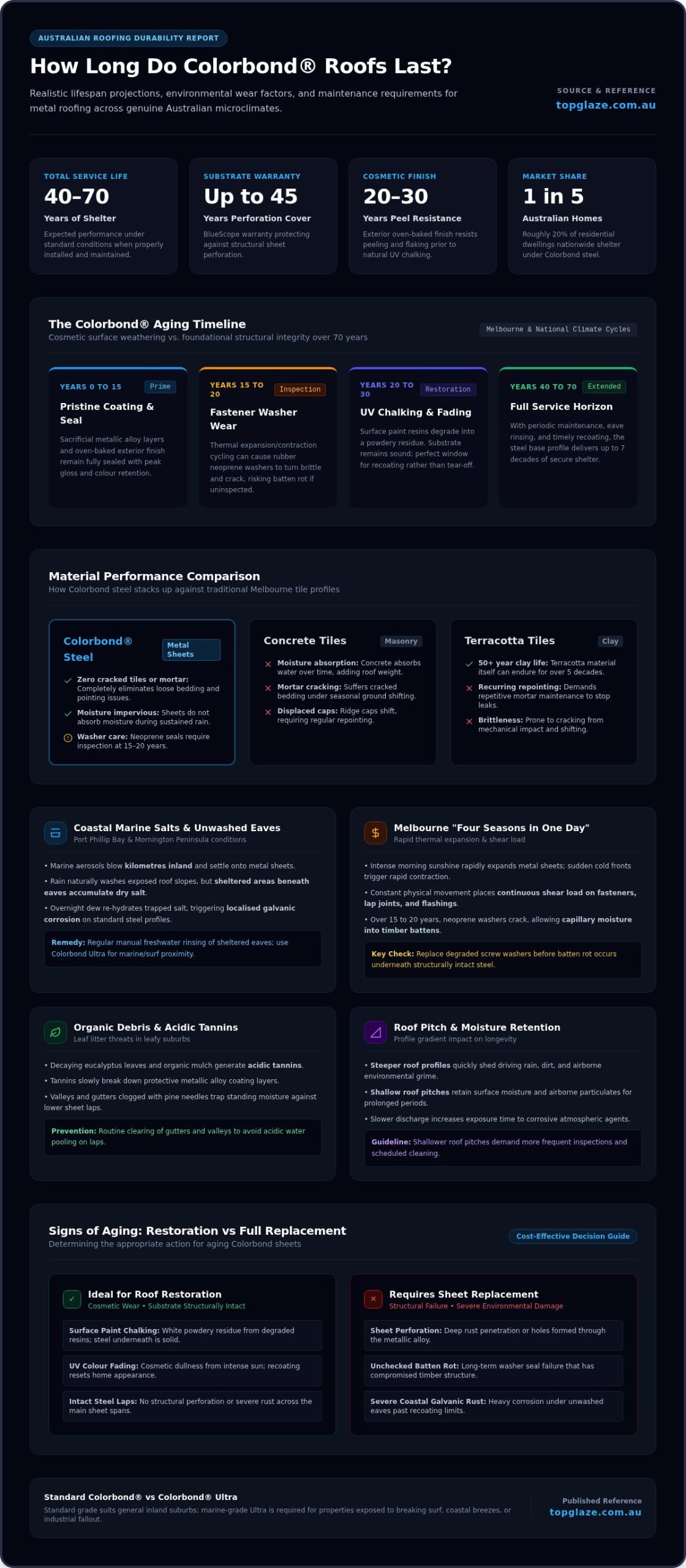
When asking how long do Colorbond roofs last under real conditions, the standard answer of 40 to 70 years only tells half the story. BlueScope warranties protect against sheet perforation for up to 45 years, but on-the-roof longevity depends heavily on physical movement and local climate stress. Melbourne’s notorious “four seasons in one day” creates rapid thermal cycling. Metal expands during blazing midday heat and contracts quickly as cold fronts sweep across Port Phillip Bay, placing steady physical demands on fasteners, lap joints, and perimeter flashings long before the steel sheet itself degrades.
Cosmetic Lifespan vs Structural Integrity
Homeowners often confuse cosmetic weathering with genuine structural failure. Deeply rooted in Australian steel coating history, modern prepainted coil steel is engineered with sacrificial metallic alloy layers underneath an oven-baked exterior finish.
The exterior finish resists peeling and flaking for 20 to 30 years. Over time, intense ultraviolet radiation causes slight colour fading and surface chalking, a powdery residue left by degraded paint resins. While this makes older sheets look tired, the underlying steel substrate remains structurally sound. A professional roof restoration recoating can completely reset your home’s exterior appeal without the need for a total roof tear-off.
Colorbond Steel Compared to Concrete and Terracotta
Understanding how long do Colorbond roofs last also involves looking at how metal stacks up against masonry alternatives. Concrete tiles absorb moisture over time, and both concrete and terracotta suffer cracked bedding and displaced ridge caps under seasonal ground shifting. While terracotta can endure for over 50 years, it demands recurring repointing maintenance to prevent interior leaks. Colorbond steel eliminates cracked tiles and loose mortar entirely. For a direct comparison of traditional materials, take a look at the homeowner’s guide to roof tile roofing in Melbourne.
Key Environmental Factors That Affect Colorbond Durability
Every microclimate treats metal roofing differently. Asking how long do Colorbond roofs last across Victoria requires looking past general averages and examining your specific property boundary. Roof pitch plays a decisive role. Steeper profiles shed driving rain and airborne grime quickly, while shallow pitches retain surface moisture and airborne particulates longer.
Coastal Salt Spray and Marine Proximity
Properties situated near Port Phillip Bay or along the Mornington Peninsula face constant airborne marine aerosols. Wind carries salt crystals kilometres inland, where they settle onto roof profiles. While rain cleans exposed slopes, unwashed zones sheltered by deep eaves or overhanging upper storeys accumulate dry salt deposits. As overnight dew hydrates this salt residue, it triggers localised galvanic corrosion on standard steel profiles that lack specialised marine coating protection.
Debris Accumulation and Moisture Retention
Leaf litter presents another serious threat across leafy Melbourne suburbs. Decaying eucalyptus leaves and organic mulch produce acidic tannins that slowly eat through protective metallic coatings. When gutters and valleys choke with pine needles and gum leaves, water pools against lower sheet laps rather than discharging cleanly. To safeguard these critical points, check your drainage system against the ultimate roof gutter checklist. If your gutters have begun overflowing onto fascia boards, having the team at Top Glaze Roofing Systems evaluate your roof drainage can stop moisture from creeping into timber framing.
Thermal Cycling and Melbourne Four-Seasons-in-a-Day Weather
Melbourne’s rapid temperature shifts cause constant expansion and contraction throughout metal roof assemblies. Sheeting expands in fierce morning sun, then contracts within minutes when an afternoon cold front rolls through. This physical cycling places continuous shear load on fasteners. Over 15 to 20 years, rubber neoprene washers can turn brittle, crack, and back out slightly. Once that seal degrades, fine lines of capillary moisture seep into structural roof battens, rotting the timber beneath long before the steel sheet reaches the end of its life.
Colorbond Steel Specifications: Standard vs Colorbond Ultra
Steel specification plays a massive role in answering how long do Colorbond roofs last. Many homeowners assume all factory sheets share identical metal cores, but BlueScope engineers distinct grades matched to specific atmospheric corrosion categories. Standard Colorbond features an Activate technology metallic coating of zinc, aluminium, and magnesium with a coating mass of AM100. This provides exceptional sacrificial protection for typical suburban environments, but severe coastal corridors demand a heavier protective barrier.
Installing standard sheeting in an aggressive marine environment will significantly shorten the roof’s working life. Even worse, using an under-specified grade can void the manufacturer’s corrosion warranty entirely.
When to Upgrade to Colorbond Ultra
Colorbond Ultra is engineered specifically for coastal zones and harsh atmospheric settings. It utilises an upgraded metallic coating mass of AM150, delivering a thicker protective shield against salt attack.
Consider upgrading to Ultra under these specific conditions:
- Coastal proximity: Homes situated between 200 metres and one kilometre from breaking surf or exposed coastal waters.
- Industrial exposure: Properties located near heavy industrial operations, chemical facilities, or fallout zones.
- Edge creep resistance: Sites facing persistent ocean winds that drive salt mist into lap joints and unpainted cut edges.
While standard profiles might only reach 20 to 30 years in harsh marine conditions, Colorbond Ultra extends that service life to 40 years or more by keeping salt from reaching the core steel.
Fastener Selection and Galvanic Incompatibility
Your roofing sheets are only as secure as the fixings holding them down. Securing premium sheeting with low-grade screws is a costly shortcut that ruins roof integrity. When two incompatible metals touch in the presence of moisture, galvanic corrosion takes hold, eating away the sheet around the screw hole.
Australian Standards require Class 4 coated fasteners for external roofing installations. These fixings match the design life of Colorbond profiles. Material compatibility also extends beyond screws: never install lead flashing or direct copper air-conditioning runoffs onto or above Colorbond sheeting. Water washing over copper or lead carries microscopic ions that strip the zinc-aluminium coating in months, causing premature rusting regardless of the steel grade.
How to Maintain Your Colorbond Roof to Reach 50+ Years
Achieving the upper limits of how long do Colorbond roofs last requires routine preventative care. While natural rainfall washes open pitches cleanly, relying solely on wet weather leaves critical vulnerabilities unaddressed. A disciplined maintenance rhythm prevents minor surface dirt from turning into structural decay, protecting both your home and manufacturer warranty compliance.
Hosing Down Sheltered and Unwashed Areas
Every six months, direct a garden hose at sections sheltered from rainfall. These areas include overhangs beneath eaves, wall cladding under verandas, and high-pitch junctions sheltered by upper levels. Salt crystals, vehicle exhaust residues, and industrial fallout accumulate continuously in these pockets. Rinse these surfaces with clean, fresh water and a soft-bristled nylon brush. Avoid high-pressure washers entirely; concentrated pressure can strip the baked factory finish, compromise lap joints, and void your BlueScope warranty.
Gutter Maintenance and Debris Clearance
Organic debris acts like a sponge, holding acidic moisture against steel edges. Leaf litter decaying in valleys and gutters quickly strips sacrificial metallic coatings from cut edges. Clearing your drainage channels before winter rains and late spring storms stops standing water from ponding against roof sheets.
Many homeowners minimise seasonal maintenance hazards by arranging professional gutter guard installation, which stops heavy gum leaves and pine needles from choking the drainage run entirely.
Inspecting Screws, Washers, and Flashings
Fastener health dictates the watertight integrity of your entire roof assembly. Every five years, complete a thorough ground or ladder check of screw lines and flashings:
- EPDM washers: Look for dry rot, flaking rubber, or visible splitting around the fastener head.
- Fastener tension: Identify screws that have backed out under cyclic roof movement or were over-driven during installation.
- Flashing laps: Check that scribed flashings around chimneys, parapets, and skylights remain sealed against wind-driven rain.
Addressing minor fastener wear early prevents water from trickling down internal roof timbers. If you spot signs of water tracking or degraded fixings, arrange expert roof repairs in Melbourne. To protect your home against the elements, schedule an assessment with the team at Top Glaze today.
Signs of Aging: Should You Restore or Replace Your Colorbond Roof?
Every homeowner evaluating how long do Colorbond roofs last eventually faces a critical crossroad: does the roof simply need a protective recoat, or has the metal reached the end of its useful service life? The answer hinges on distinguishing cosmetic surface weathering from terminal substrate decay. While some contractors recommend full tear-offs prematurely and others attempt to paint over rusted steel, making the right choice requires a clear, practical assessment of the metal’s condition.
Top Glaze provides transparent roof inspections to assess the true condition of your sheeting, giving you an honest appraisal backed by decades of experience across Melbourne and the Mornington Peninsula.
When Roof Restoration Is the Smartest Choice
Roof restoration is the most sensible, cost-effective option when the underlying steel remains structurally sound. If the sheets are intact without pinholes or through-metal corrosion, degraded paint is merely an aesthetic concern.
Restoration makes complete sense if you observe:
- Surface chalking and fading: The original colour has lost its lustre and rubs off as a light powder on your fingertips.
- Micro-crazing: Fine hairline fissures appear in the topcoat without exposing raw brown rust beneath.
- Isolated surface oxidation: Light, superficial oxidation that can be treated, primed, and resealed.
Applying a specialised multi-coat protective membrane seals the surface, shielding the factory substrate and extending its service life by another 10 to 15 years. To understand what this multi-stage process involves, explore the ultimate guide to roof restoration Melbourne.
When Complete Roof Replacement Becomes Inevitable
Paint cannot fix perforated steel. Once rust penetrates through the metal core or eats along sheet overlaps, restoration coatings will only conceal a failing structure that continues to deteriorate underneath.
Full replacement is the only safe path forward when dealing with:
- Through-metal corrosion: Visible perforations, pinholes, or crumbly rust patches along the lower sheet edges.
- Capillary lap rust: Dark corrosion spreading within hidden side laps where two sheets join, preventing a watertight seal.
- Internal timber damage: Persistent leaks that have rotted roof battens, weakened rafters, or sagged ceiling plaster.
Investing in a fresh installation resets your property’s timeline entirely, giving you decades of leak-free protection. Learn what a complete upgrade entails through our guide on full roof replacement in Melbourne. At Top Glaze, every residential replacement is carried out by licensed specialists and supported by an unyielding 10-year workmanship warranty for lasting peace of mind.
Securing the Long-Term Future of Your Colorbond Roof
Getting a definitive answer to how long do Colorbond roofs last comes down to your local microclimate, consistent maintenance, and knowing whether surface wear warrants a protective recoat rather than a premature tear-off. Simple habits like rinsing sheltered eaves and replacing perished fastener washers can easily add decades of life to your sheeting.
When you need honest clarity on your roof’s condition, genuine local expertise makes all the difference. Top Glaze is a family-owned Australian business that has protected Victorian homes since 1987. With over 30 years of experience, our fully licensed trades deliver unbiased roofing evaluations and dependable workmanship, backing residential projects with a 10-year warranty.
Take the guesswork out of your home’s protection. Book a comprehensive roof inspection with Top Glaze today to keep your Colorbond roof performing at its best for decades to come.
Frequently Asked Questions
How many years does a Colorbond roof last compared to tile roofs?
A properly installed Colorbond roof generally lasts between 40 and 70 years, while terracotta or concrete tiles can technically survive for 50 years or more. However, tile roofs require recurring structural upkeep, such as re-bedding and repointing brittle mortar ridge caps every decade. When assessing how long do Colorbond roofs last compared to masonry, metal provides continuous, crack-free protection without the weight stress and moisture absorption common to aging tiles across Melbourne suburbs.
Does Colorbond steel rust over time in Melbourne?
Genuine Colorbond steel resists corrosion for decades thanks to its Activate zinc-aluminium-magnesium alloy barrier. Surface rust only develops if that sacrificial metallic layer gets breached. Common culprits across Melbourne include wet eucalyptus leaf litter trapping moisture in valleys, unwashed sea salt accumulating beneath eaves, or incompatible runoffs from copper air-conditioning piping. Without these adverse triggers, the metal core remains completely sound throughout its working life.
Can you repaint a faded Colorbond roof instead of replacing it?
Yes, repainting a sound Colorbond roof through a professional restoration process is an ideal alternative to replacement. If the sheeting hasn’t perforated and shows no deep seam rust, you don’t need a total tear-off. Applying a specialised metal roofing primer and multi-coat protective membrane seals surface chalking, shields the substrate from UV degradation, and extends your roof’s service life by another 10 to 15 years.
How do I know if my Colorbond roof requires Colorbond Ultra?
Your property requires Colorbond Ultra if it sits within 200 metres to one kilometre of breaking surf or coastal salt spray. In bayside Melbourne and across the Mornington Peninsula, standard AM100 coating profiles face aggressive salt deposition that can void standard BlueScope warranties. Colorbond Ultra provides a heavier AM150 metallic coating mass specifically engineered to resist salt attack, marine dampness, and severe industrial fallout.
What causes Colorbond roof screws to deteriorate before the sheets?
Roof fasteners deteriorate faster than steel sheets because their flexible EPDM rubber washers bear the brunt of Melbourne’s daily thermal cycling and UV rays. Over 15 to 20 years, these rubber seals dry out, become brittle, and crack. If low-grade fixings were installed instead of compliant Class 4 coated screws, galvanic reaction also corrodes the fastener shank, allowing slow moisture ingress into the structural timber battens beneath.
How often should unwashed areas of a Colorbond roof be cleaned?
Sheltered and unwashed areas of your roof should be washed down with clean, fresh water at least once every six months. Sections under veranda returns, eaves, and sheltered wall cladding never receive natural rain cleaning. In urban and coastal Victoria, salt spray and airborne dirt settle into these quiet pockets, triggering micro-corrosion. A gentle rinse with a garden hose and soft brush keeps your warranty valid and preserves the factory finish.
Does walking on a Colorbond roof damage its protective coating?
Walking on a Colorbond roof will not scratch or damage the factory finish if done correctly using clean, soft-soled footwear. Foot traffic should always be kept to a minimum and directed strictly over roof battens and in the sheet pans. Never tread on high ribs or unsupported sheet spans, as denting can trap standing water and stretch the baked surface paint. For safety and roof preservation, leave high-level inspections to licensed roofing specialists.


