

For an ember guard for gutters in Melbourne, the key starting point is mesh with apertures no larger than 2 mm, made from a material suited to the home’s Bushfire Attack Level (BAL). Ember guards are designed to help block embers entering through gutters and roof openings, but no bushfire protection option is completely fireproof.
It’s understandable to focus on the mesh first. The material matters, but so does whether the guard suits your BAL rating and the way your roof and gutters are built. Standard gutter mesh may be plastic or steel and designed to block leaves or pests. Ember protection, by contrast, calls for fire-resistant material and a suitably small aperture.
This guide compares steel, bronze, aluminium and standard gutter mesh, then explains how BAL requirements and roof compatibility affect a retrofit. You’ll see what to consider for tiled and metal roofs, how ember guards relate to guttering and roof cavities, and why a suitable option needs to balance ember resistance with effective drainage.
Key Takeaways
- Look for ember mesh with apertures no larger than 2 mm, then match its material to the home’s BAL rating.
- Compare steel, bronze and aluminium by their suitability for the required BAL, as well as their fit with the roof and gutters.
- Standard gutter mesh is designed for debris or pests; ember protection needs mesh or perforated sheet suited to blocking embers while allowing water to drain.
- Before retrofitting, consider how the roof is constructed. Tile placement and gutter design affect how a guard can be fitted.
- Use the article’s decision guide to narrow down the mesh options and identify when roof or guttering work may be part of the solution.
Ember mesh protection for bushfire-prone properties
For bushfire-prone homes, ember mesh is designed to block embers at roof openings while allowing rainwater to drain. The mesh, material and gutter fit all matter.
Ember guard mesh and gutter guard mesh
Standard gutter guard mesh is made from materials such as plastic or steel, with openings suited to the debris or pests it is intended to block. Ember guard mesh has a different purpose: it uses fire-resistant material and a small aperture to help prevent embers entering through gutters and roof cavities. Some fire-rated guards can provide both debris and ember protection.
In Melbourne, look for a roofing or guttering installer experienced with ember-rated mesh and roof interfaces. The suitable installation depends on the gutter and roof construction, not simply the mesh label.
Mesh aperture and fire-resistant materials
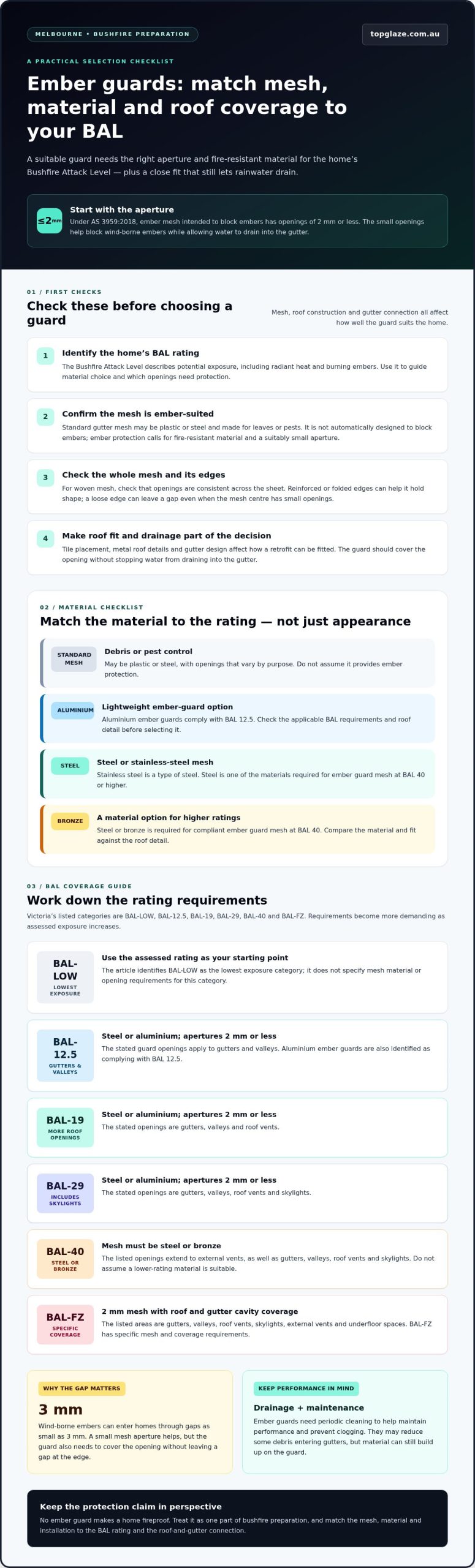
Under AS 3959:2018, ember mesh intended to block embers has an aperture of 2 mm or less. That small opening helps keep wind-borne embers from passing through, while the mesh still allows water to drain into the gutter. A larger opening may suit leaf debris but isn’t equivalent ember protection.
Fire-resistant mesh can be made from materials such as aluminium, steel or bronze. No mesh makes a home fireproof, so treat the guard as one part of bushfire preparation, not a complete solution.
Woven mesh and reinforced edges
Woven mesh is formed from strands crossing over and under each other, creating repeated openings across the sheet. Check the aperture across the entire mesh, not just at one point, as consistent openings support its intended ember-blocking function. Reinforced or folded edges can help the mesh hold its shape where it meets a gutter or roofline.
For example, a loose edge can leave a gap even if the centre of the mesh has small openings. A close-fitting edge and secure attachment help prevent this weak point.
Aluminium and stainless-steel mesh
Aluminium mesh is a lightweight option, and aluminium ember guards comply with BAL 12.5. Steel mesh is another option; stainless steel is a type of steel, while steel or bronze is required for homes at BAL 40 or higher. Match the material to the home’s rating and the roof detail, rather than choosing by appearance alone.
Ember guard lifespan and warranty periods vary by product. Material, installation, exposure and maintenance affect service life, while warranty terms depend on the product.
Ember guards need periodic cleaning to maintain performance and prevent clogging. They can reduce some debris entering gutters, but you’ll still need to clear material that builds up on the guard.
| Option | Primary purpose | Material or rating consideration | Key comparison |
|---|---|---|---|
| Standard gutter guard mesh | Debris or pest control | Plastic or steel; mesh size varies | Not automatically designed for ember protection |
| Aluminium ember mesh | Ember protection and drainage | Complies with BAL 12.5 | Lightweight material option |
| Steel or stainless-steel mesh | Ember protection and drainage | Steel or bronze for BAL 40 or higher | Check aperture and roof fit |
| Bronze ember mesh | Ember protection and drainage | Steel or bronze for BAL 40 or higher | Compare with steel against the roof detail |
Choose a guard by matching the BAL rating, mesh aperture and material to the roof and gutter connection.
Australian bushfire standards and BAL ratings
A Bushfire Attack Level (BAL) describes a home’s potential exposure to bushfire attack, including radiant heat and burning embers. In Australia, the BAL rating helps determine which ember protection materials and building details are suitable.
Bushfire Attack Level material requirements
AS 3959:2018 sets requirements for ember protection across BAL ratings, including the materials and openings covered by guards. At BAL-12.5, steel or aluminium ember guards for gutters and valleys need mesh apertures of 2 mm or less. At BAL-19, the same aperture limit applies to steel or aluminium guards for gutters, valleys and roof vents.
At BAL-40, compliant ember guard mesh must be steel or bronze. BAL-FZ has specific requirements for mesh and coverage, so don’t assume a material suitable at a lower rating is suitable at this level.
Bushfire Attack Level suitability
Victoria has 6 Bushfire Attack Levels: BAL-12.5, BAL-19, BAL-29, BAL-40, BAL-FZ and the lowest exposure category, BAL-LOW. Requirements become more demanding as the assessed exposure increases. For example, BAL-29 covers steel or aluminium ember guards for gutters, valleys, roof vents and skylights, with mesh apertures of 2 mm or less.
For BAL-40, the listed openings extend to external vents, and the mesh material must be steel or bronze. BAL-FZ covers gutters, valleys, roof vents, skylights, external vents and underfloor spaces. Its ember mesh must be 2 mm and cover roof and gutter cavities. These distinctions make the rating an essential starting point for selecting protection.
Ember entry and ignition risk
Wind-borne embers can enter homes through gaps as small as 3 mm, then ignite combustible material in roof spaces or around eaves. Gutters and roof cavities are among the areas where a correctly fitted mesh guard can help block ember entry. The small aperture matters, but so does covering the opening without leaving a gap at the edge.
Ember protection reduces one pathway for burning embers, but it doesn’t make a home fireproof. Use the BAL rating to identify which openings and materials need attention, then consider how the mesh joins the roof and gutter. This is more useful than treating a gutter guard as a complete bushfire solution.
For a property with complex roof or gutter connections, an assessment of roof and guttering work can help identify how those details fit into the wider protection plan.
What is Ember Guard?
An ember guard is mesh or perforated sheet fitted over openings such as gutters to help block burning embers from entering roof spaces. It can help protect gutters from ember entry when the mesh, material and fit suit the home’s BAL rating.
The key difference from an ordinary gutter guard is its purpose. Standard gutter guards are designed mainly to limit leaves, debris or pests entering gutters. They may be plastic or steel, with mesh sizes varying according to what they’re intended to keep out. A guard that catches leaves isn’t automatically suitable for ember protection.
Ember protection focuses on restricting ember entry through gutters and roof cavities. Under AS 3959:2018, ember mesh intended to block embers has an aperture of 2 mm or less. It may be non-combustible mesh or perforated sheet. The small openings help block embers while allowing water to drain towards the downpipe.
Some fire-rated gutter guards combine debris and ember protection, which can be practical for a home in a bushfire-prone area. But the product label alone doesn’t establish suitability. Compare the aperture and material with the relevant BAL requirements, and consider whether installation will cover the opening without leaving gaps.
Material matters because suitable options change with the rating. Aluminium ember guards comply with BAL 12.5, while BAL-40 and BAL-FZ compliant ember guard mesh must be made from steel or bronze. These differences show why a general leaf guard and a rating-suitable ember guard aren’t interchangeable, even if both sit over the gutter.
For example, on a tiled roof, leaves may collect along the gutter while embers can enter through a gap between the guard and roof edge. Choosing an ember guard for gutters in Melbourne means considering that roof junction, not just the gutter channel. How the mesh meets tiles, valleys and gutter edges affects which openings it covers.
To compare options, start with the home’s BAL rating, then match the mesh material and aperture to the openings that need protection. Consider whether the product also controls debris, how water drains through it, and whether the roof detail leaves exposed gaps. This gives Melbourne homeowners a practical basis for choosing an ember guard for gutters, rather than relying on appearance or a broad product label.
Ember protection can help reduce one route for ember entry, but no guard makes a home completely fireproof. Keep the distinction clear: a leaf guard is primarily for debris, while an ember guard is selected for ember resistance and the property’s roof conditions.
Fire-resistant and corrosion-resistant materials
Material selection involves two separate checks: whether gutter mesh suits the bushfire requirements and whether it suits the roof environment. AS3959-2009, AS 3959:2018 and the home’s BAL rating each inform that decision.
Gutter guard materials under AS3959-2009
AS3959-2009 requires gutter guards used on new homes in bushfire-prone areas to be made from non-combustible material, such as steel. It doesn’t require gutter guards to be installed on those new homes. The distinction matters: where a guard is used, its material is relevant, but the standard does not make a guard compulsory for every new home.
That material rule is not the same as selecting ember mesh for a particular BAL. For example, AS 3959:2018 specifies ember protection requirements that vary with the rating and the openings being covered.
Non-combustible gutter guard materials
Steel is an example of non-combustible gutter guard material under AS3959-2009. For ember guards, material suitability also changes with BAL: aluminium may be used at BAL-12.5 or BAL-29, while BAL-40 and BAL-FZ compliant mesh must be steel or bronze. The rating therefore helps narrow the material choice.
Fire resistance and corrosion resistance are separate considerations. A material suited to a bushfire rating still needs to suit the roof and gutter environment. Compare the mesh with the existing gutter material, its exposure and how water drains through it.
Use these checks to compare a proposed mesh option:
- Rating: Match the material to the home’s BAL, such as aluminium for BAL-12.5 or steel or bronze at BAL-40.
- Aperture: For ember protection under AS 3959:2018, check that the mesh opening is 2 mm or less.
- Coverage: Check that the guard covers the relevant gutter or roof opening, rather than leaving a gap at an edge.
- Drainage: Consider whether water can pass through the mesh into the gutter without debris blocking the openings.
These checks address different performance needs. A non-combustible guard material doesn’t alone establish that the mesh has an ember-suitable aperture or covers the required opening. Conversely, a fine mesh needs a suitable material for the property’s rating. A BAL-12.5 example may permit aluminium, while a BAL-FZ installation calls for steel or copper mesh covering roof and gutter cavities.
Consider corrosion resistance alongside the rating, not as a substitute for it. Roof exposure, contact with the gutter and accumulated debris can affect how a guard performs over time. Ember guards need periodic cleaning to maintain performance and prevent clogging, so consider maintenance access when comparing materials and installation details.
For a Melbourne home, the practical sequence is clear: establish the BAL, identify the openings needing coverage, then compare material, aperture, drainage and fit. This helps distinguish a fire-resistant option from a general leaf or debris guard and ensures each requirement is considered.
Retrofitting ember guards and roof compatibility
Retrofitting an ember guard for gutters in Melbourne starts with the roof connection, not just the gutter channel. Existing gutter systems can be upgraded with ember-proof mesh, but the roof structure and material determine how the guard can fit.
Start with the roof-to-gutter junction
Before selecting mesh, identify where the roof edge, valleys and gutters meet. These junctions show which openings a retrofit needs to cover. A guard can span the gutter channel yet leave a gap beside the roof edge, so assess the full connection.
On tiled roofs, gutter guard is installed underneath the second row of tiles. This affects how the mesh meets the roof covering and sits at the edge. Metal roofing has a different profile, so its structure and material shape the fitting details.
Check the whole installation path
Map the areas needing protection before installation. Include gutters and valleys, then consider roof vents, skylights or other openings relevant to the home’s BAL rating. AS 3959:2018 requirements vary by rating and opening type, so assess each location rather than treating every roof edge alike.
Next, compare the mesh aperture and material with the applicable requirements. Ember mesh intended to block embers has an aperture of 2 mm or less. The attachment should cover the intended opening without leaving exposed edges. At a valley, for example, rainwater must still drain towards the gutter.
Allow for roof condition and maintenance
Existing roofing can affect how securely a guard fits. Loose or damaged components, uneven tile lines or altered gutter edges can change the connection. Addressing these conditions during roofing work can help avoid forcing mesh into an unsuitable position. The retrofit must protect the opening while preserving the route rainwater takes into the gutter.
Homeowners should also plan for cleaning after installation. Ember guards need periodic cleaning to maintain performance and prevent clogging. Leaves and debris can build up on the mesh, so consider access and a practical cleaning method. A blocked section can restrict drainage even if the guard remains securely fitted.
A practical retrofit sequence
- Identify the home’s BAL rating and the roof openings requiring ember protection.
- Note the roof type, gutter profile, valleys and gaps at the junctions.
- Match the mesh aperture and material to the relevant rating requirements.
- Fit the guard to the roof detail while preserving drainage and cleaning access.
This sequence helps homeowners assess an ember guard for gutters in Melbourne by compatibility, coverage and maintenance, rather than appearance alone. For help with roof and guttering needs, discuss your roof and guttering project.
Top Glaze Roofing Systems: Roof Restoration
Top Glaze Roofing Systems can help homeowners address roof and gutter issues that affect how an ember guard retrofit fits. Roof Restoration is relevant when the existing roof needs broader attention, while Roof Repairs can address localised damage that may affect the roof-to-gutter connection.
If the roof needs a more extensive change, Roof Replacement may be the appropriate option. Guttering & Fascia can address guttering concerns that influence how protection fits around the roof edge. The right work depends on the condition and construction of the existing roof and gutters.
For help deciding which roofing or guttering work suits your home, contact Top Glaze Roofing Systems to discuss the project.
Make your next roofing decision with confidence
Choosing an ember guard for gutters in Melbourne is also an opportunity to consider the roof as a complete system. A guard works alongside sound roofing, secure gutters and well-maintained connections. If the roof condition or gutter alignment needs attention, address those issues when planning the next step.
Top Glaze Roofing Systems offers Roof Restoration, Roof Replacement and Roof Repairs to help homeowners tackle roofing needs that may affect a gutter protection project. The right work depends on what the roof requires, from restoring existing materials to repairing damage or replacing the roof.
Bring your questions about the roof and gutter connection to the conversation. Contact Top Glaze Roofing Systems to discuss the work your home needs. A clear plan can make the next decision feel more manageable.
Frequently Asked Questions
What is a gutter guard?
A gutter guard is a cover or mesh fitted over a gutter to limit leaves, debris or pests entering the channel. Standard options include plastic and steel mesh, with openings that vary according to what they’re designed to block. For example, mesh intended to catch leaves may have different openings from mesh designed for smaller debris. A guard can reduce material entering gutters, but it still needs periodic cleaning.
What is Ember Guard gutter protection?
Ember guard gutter protection is mesh or perforated sheet fitted over roof and gutter openings to help block burning embers. Its purpose differs from ordinary leaf protection: the aperture and material are selected for ember resistance, while the design also allows water to drain. For a Melbourne home, compare the guard’s material and coverage with the property’s BAL rating and roof layout before choosing an option.
Is Ember Guard compliant with Australian Standards for bushfire protection?
Compliance depends on the mesh material, aperture, openings covered and the home’s BAL rating. Under AS 3959:2018, ember mesh intended to block embers has an aperture of 2 mm or less. For example, BAL-40 and BAL-FZ compliant ember guard mesh must be steel or bronze. A product name alone doesn’t establish that an installation meets the requirements for a particular home.
Can Ember Guard be installed on existing gutters and different roof types?
Yes, existing gutter systems can be upgraded with ember-proof mesh, but the roof-to-gutter connection affects the installation. On tiled roofs, gutter guard is installed underneath the second row of tiles. Metal roofing has a different profile and connection detail. In either case, the fit needs to cover the intended opening without obstructing drainage. The roof structure and material determine how the mesh can be attached.
What are the risks or limitations of Ember Guard in a bushfire?
An ember guard can help block one route into the roof, but no bushfire protection option is completely fireproof. Gaps at edges or other uncovered openings can still allow embers to enter, and mesh can collect leaves and debris. Periodic cleaning helps prevent clogging and maintain performance. Treat gutter protection as one part of a broader bushfire preparation plan, not a substitute for addressing other exposed parts of the home.
Are there rebates, grants, or council requirements for ember protection in Victoria?
Rebates and grants depend on the terms of active programmes, while council requirements can vary with the property and proposed work. For a practical starting point, ask your local council about the home’s BAL rating and any relevant planning or building requirements. The rating guides which ember protection details to consider. Keep council guidance together with product and installation information for the property.
How long does Ember Guard last and what warranty is offered?
Lifespan varies with material, installation, exposure and maintenance. The listed ember guards carry a 15-year warranty.


