

Why does the “cheapest” quote for your home often end up being the most expensive mistake you’ll ever make? We understand that when you start looking into the cost of new roof melbourne projects, the range of prices can be nothing short of dizzying. It’s frustrating to deal with “cowboy” tradies who provide vague estimates, only to surprise you later with hidden fees for scaffolding or asbestos disposal. You want a fair price, but more importantly, you want the certainty that your family is protected from Melbourne’s volatile weather for the next few decades.
We agree that your roof is far too important to leave to guesswork or temporary patch-ups that fail at the first sign of a storm. This guide will show you exactly what influences the price of a new roof in Melbourne this year and how to budget for a high-quality residential result that stands the test of time. We’ll walk through the impact of the latest 2026 Victorian building standards, compare the long-term value of different materials, and help you determine whether a restoration or a total replacement is the most sensible path for your home’s future and your peace of mind.
Key Takeaways
- Understand how 2026 material supply chains and updated building standards influence the current cost of new roof melbourne projects for residential properties.
- Learn why your choice of material is the biggest variable in your budget and how to assess if your home requires structural repairs to its battens or rafters.
- Prepare for essential “hidden” costs, including WorkSafe-mandated scaffolding and the safe disposal of asbestos often found in mid-century Melbourne homes.
- Evaluate the financial trade-offs between a roof restoration and a full replacement to determine which provides the best long-term security for your investment.
- Discover how to vet local roofing contractors to ensure you receive a transparent, professional quote from a seasoned local expert.
Understanding the Price Range for Melbourne Roofing in 2026
In 2026, the landscape for home improvements has shifted. Supply chain fluctuations that once caused major delays have largely stabilised, yet they’ve left behind a new baseline for material costs. When you’re investigating the cost of new roof melbourne homeowners are finding that quotes reflect these updated economic realities alongside stricter compliance requirements. We’ve seen that a quote from two years ago simply won’t align with the current market, especially with the introduction of the 2026 Victorian Guide to Standards and Tolerances.
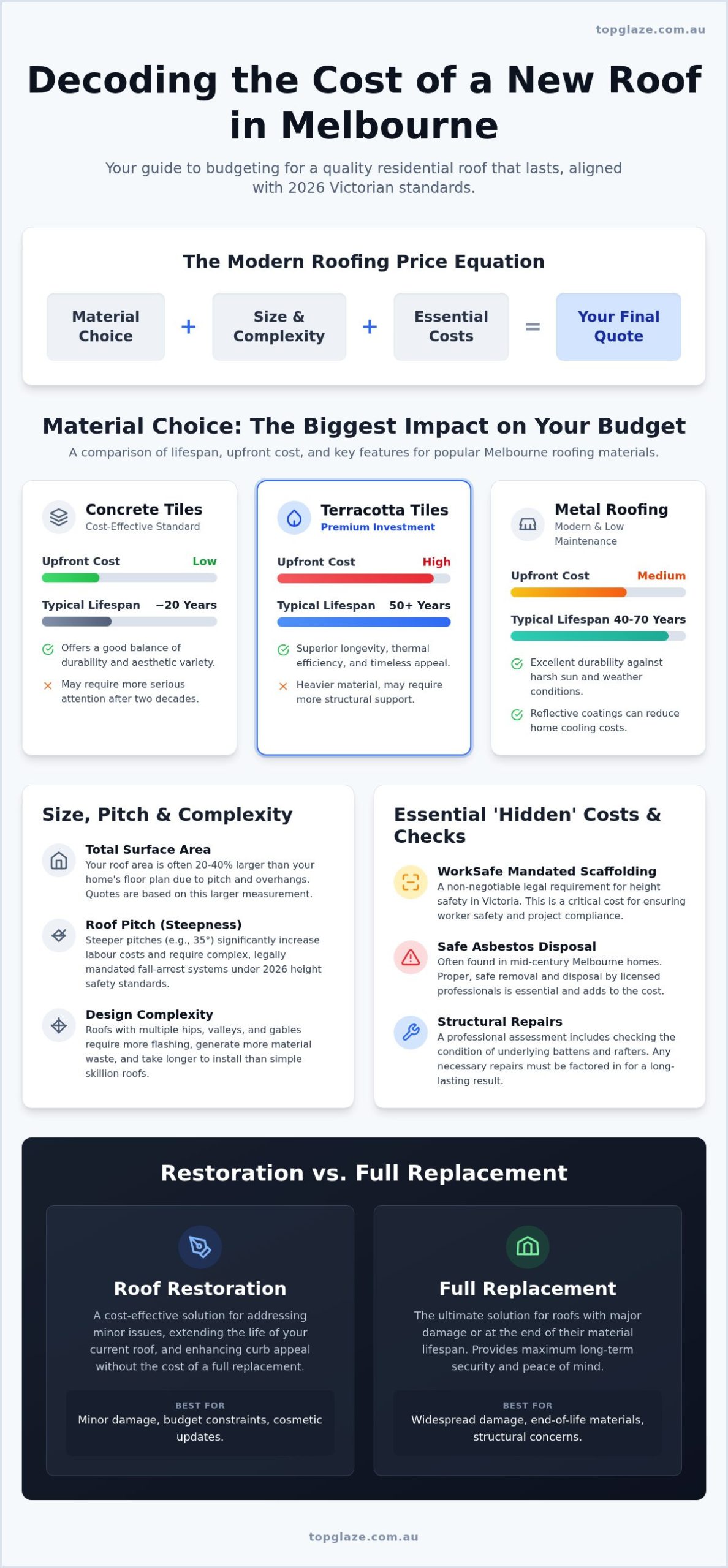
A typical Melbourne home, whether it’s a compact unit in Coburg or a sprawling family residence in Glen Waverley, will fall into different pricing brackets based on its total surface area. It’s a common mistake to use your home’s “footprint” to estimate costs. Your roof’s surface area is often 20% to 40% larger than the floor plan due to the pitch and overhangs. This is why a “per square metre” rate is merely a starting point; it doesn’t account for the unique geometry of your specific property.
Estimating Costs by Material Type
Your choice of material is the most significant lever you can pull to manage your budget. Concrete tiles remain a cost-effective standard for many suburban developments, offering a balance of durability and aesthetic variety. For those seeking a heritage look or maximum longevity, terracotta tiles represent a premium investment. They’re heavier and require more structural support but offer a timeless appeal that suits Melbourne’s older suburbs. Modern homeowners often opt for metal systems like Colorbond. These are prized for their low maintenance and ability to withstand the harsh Victorian sun. You can learn more about these options in this guide to roofing materials, which outlines the structural differences between clay, metal, and synthetic choices.
How Home Size and Pitch Affect the Bottom Line
The “steepness” or pitch of your roof plays a massive role in the final figure. Under the updated 2026 height safety standards, steeper pitches require more complex fall-arrest systems and scaffolding. This isn’t just a recommendation; it’s a legal necessity to protect workers and ensure your project stays compliant with WorkSafe Victoria. A roof with a 35-degree pitch involves significantly more labour hours than a 15-degree pitch because movement is slower and safety protocols are more rigorous.
Complexity also adds to the tally. A simple skillion roof is much faster to install than a complex design featuring multiple hips, valleys, and gables. Every time a roof changes direction, more flashing is required and more material waste is generated. When we assess a property, we look at these structural details to provide a quote that reflects the actual work involved, rather than a generic estimate that might lead to “hidden” extras later on. By understanding these variables, you can move from a vague guess to a realistic budget for your home’s protection.
Primary Factors Influencing Your New Roof Quote
When we sit down to calculate the cost of new roof melbourne homeowners often ask why two similar-looking houses in the same street receive different quotes. It rarely comes down to just the size of the house footprint. Instead, a professional quote reflects a combination of material quality, the hidden condition of your home’s skeleton, and the logistical hurdles unique to your property. A seasoned expert looks past the surface to ensure the structure can actually support your new investment without failing a few years down the road.
Material Lifespan vs Upfront Cost
Choosing between materials isn’t just about the look; it’s a decision about how many times you want to do this in your lifetime. Basic concrete tiles might have a 20-year cycle before they require serious attention, whereas terracotta roof tiles are a premium choice with a 50-year potential. While the upfront investment is higher, the thermal efficiency and longevity of terracotta or modern metal finishes often make them more economical over time. Metal roofing, in particular, has seen advancements in reflective coatings that significantly reduce cooling costs during a Melbourne heatwave, providing value that continues long after the installation is complete.
Labour and Expertise Requirements
The skill required to install a roof correctly is often undervalued in “budget” quotes. In Victoria, major roofing work must be performed by licensed roof plumbers to ensure compliance with the National Construction Code 2026. Specialized roof tiling requires artisan skills that general labourers simply don’t possess. If a quote seems too good to be true, it’s often because the contractor is cutting corners on labour or lacks the necessary insurance to protect you if something goes wrong. We’ve seen many cases where a “cheap” fix required a full replacement just a few years later because the original team lacked local expertise.
Beyond materials and skill, structural integrity is a massive variable that dictates the true cost of new roof melbourne projects. If your existing battens are sagging or your rafters show signs of rot, these must be addressed before the new material is laid. Ignoring the skeleton of the roof is a recipe for disaster. Additionally, access plays a role. A home with a narrow side-driveway or a multi-storey townhouse in a busy inner-city street requires more complex logistics and safety equipment than a single-storey home with clear access. We believe in total transparency, which is why a comprehensive roof replacement assessment is the only way to get a quote you can actually rely on.
Account for the ‘Hidden’ Costs of Roofing in Victoria
When calculating the cost of new roof melbourne homeowners frequently focus on the visible materials, yet the “hidden” regulatory and safety requirements often dictate the final budget. Victoria has some of the most stringent building standards in Australia. Ignoring these isn’t just a risk to your safety; it’s a risk to your property’s legal compliance. A seasoned professional will identify these factors during the first site visit, ensuring you aren’t hit with unexpected variations halfway through the build.
Safety and Compliance Standards
Safety is a non-negotiable part of any modern roofing project. WorkSafe Victoria mandates specific “fall from heights” protection for residential worksites. This usually involves installing temporary scaffolding or perimeter safety rails. While these systems add to the initial quote, they provide essential peace of mind and protect you from the liability of a workplace accident. Additionally, the Victorian Building Authority (VBA) requires a compliance certificate for any plumbing work over a certain value. This certificate is your proof that the installation meets the National Construction Code 2026 standards, which is vital for insurance and future property sales.
Disposal fees are another factor that varies significantly across Melbourne waste centres. These facilities have strict categories for old roofing materials, and costs can climb if the site is difficult to access. If your home was built between the 1940s and 1980s, there’s a high probability of finding asbestos in the eaves or old tile backing. Safe, licensed removal of these materials is a critical cost that must be handled by experts. We never cut corners here because the health of your family and the local community is the priority.
Integrated Systems: Gutters and Fascia
It’s rarely wise to install a premium new roof while leaving old, rusted gutters in place. Most homeowners find that a gutter replacement Melbourne service is the most logical step to take during a reroof. This ensures the entire water drainage system functions as a single unit, preventing leaks at the junction between the roof and the gutter line. We also look closely at your fascia boards and eaves. If these timber elements are rotting, they must be repaired or replaced to prevent internal water damage that could ruin your ceiling. Adding a leaf guard system at this stage is a sensible way to reduce future maintenance and keep your new gutters clear of debris during Melbourne’s stormy seasons.
Local council requirements can also influence your plans. If your home sits within a heritage overlay in suburbs like Camberwell or Williamstown, you may be restricted to specific colours or traditional materials. Checking these constraints early prevents expensive mistakes and ensures your project respects the character of your local area while remaining fully compliant with planning laws.
Roof Restoration vs Full Replacement: Which is More Cost-Effective?
Deciding between a restoration and a full replacement is one of the most critical choices you’ll make for your home’s longevity. While the immediate cost of new roof melbourne projects can be significant, choosing the wrong path often leads to double-handling costs down the track. We view a restoration as a high-quality facelift that extends the life of a sound structure. A replacement, however, is a total structural overhaul. Understanding where your home sits on this spectrum is the key to protecting your investment and your family’s safety.
A restoration is essentially an aesthetic and protective refresh. It’s a proven method for maintaining property value without the price tag of a full reroof. However, when the structural integrity of the timber underneath is compromised by decades of moisture ingress, a simple coat of paint is like putting a band-aid on a broken limb. We always look for the “tipping point” where a roof is simply too far gone for a patch-up to be a responsible recommendation.
When to Choose Roof Restoration
Restoration is the ideal solution for roofs that are structurally sound but showing signs of surface degradation. This is common in 15-20 year old homes where the original tiles have become porous or the mortar has begun to crumble. A professional roof restoration melbourne package typically includes a high-pressure clean to remove moss and lichen, followed by re-bedding and re-pointing of ridge tiles. The final stage involves applying specialised primers and sealants that restore the tile’s water-shedding capabilities. It’s a methodical process that provides immediate street appeal and several more years of reliable service.
When a Full Roof Replacement Is Necessary
There are times when a restoration is no longer a viable option. If we detect widespread structural rot, sagging rafters, or multiple failed previous repairs, a full roof replacement melbourne is the only way to ensure your home remains watertight. This is also the perfect opportunity for homeowners to switch materials. Many Melbourne families are moving from traditional heavy tiles to modern metal systems for a more contemporary look and better thermal performance. While the upfront cost of new roof melbourne installations is higher for a replacement, the long-term ROI is found in reduced maintenance and significantly higher resale value. Melbourne buyers value the “set and forget” peace of mind that a brand-new roof provides. If you aren’t sure which path is right for your property, we recommend booking a professional roofing assessment to get a clear, expert opinion on your roof’s current condition.
Securing a Fair Quote from a Trusted Melbourne Roofing Specialist
Finding the right balance between quality and the cost of new roof melbourne projects requires more than just looking at the bottom line. You want to work with a “seasoned mentor” who understands the nuances of local architecture, not a high-pressure salesperson chasing a quick commission. A professional quote should be a transparent roadmap, detailing exactly where every dollar is going. If a contractor can’t explain the “why” behind their recommendations, it’s a sign they might be cutting corners on your home’s safety or the longevity of the materials.
Red flags often hide in what is omitted from a proposal. If a quote doesn’t explicitly mention WorkSafe-compliant scaffolding, waste disposal fees, or the replacement of damaged battens, you aren’t looking at the final price. These omissions usually reappear as expensive variations once the old roof is already off. A fixed-price quote from a business with a local Melbourne office and a 10-year warranty provides a level of security that a mobile-only operator cannot match. It shows they value their reputation and plan to be around for another 30 years to stand by their work.
Evaluating Contractor Credentials
Before signing any contract, you must verify that the business is fully licensed with the Victorian Building Authority (VBA). This isn’t just a formality; it’s your legal protection. We also recommend checking for current public liability insurance and a gallery of recent, local projects. Taking the time to speak with previous clients in your area can reveal a lot about a team’s punctuality and cleanliness. Truly hiring a quality roofing contractor involves looking for a partner who treats your home with the same respect they would their own.
Finalising Your Budget and Timeline
In Victoria, there are strict regulations regarding payment schedules and deposit limits for domestic building work. A reputable specialist will never ask for the full amount upfront. Instead, they’ll provide a structured schedule that aligns with project milestones. It’s also vital to discuss the timeline with realistic expectations. Melbourne is famous for “four seasons in one day,” and while we strive for efficiency, we won’t compromise the safety of your home by opening it up during a predicted storm. A comprehensive, fixed-price quote ensures that even if the weather causes a minor delay, the cost of new roof melbourne remains exactly what you budgeted for, with no stressful surprises at the finish line.
Securing Your Home’s Future with Confidence
Your roof is the primary guardian of your home, and understanding the cost of new roof melbourne projects helps you move from anxiety to action. Whether you choose a professional restoration or a full structural overhaul, the focus should always be on longevity and safety rather than just the lowest initial quote. By accounting for Victorian compliance standards and choosing durable materials, you ensure your investment stands up to our unpredictable weather. We believe that transparency is the foundation of a great relationship, and we’re here to help you navigate these decisions with ease.
As a family-owned business with 30+ years of local experience, we specialise in helping Melbourne homeowners find the right balance between quality and value. We provide a 10-year workmanship warranty on all projects and operate as a fully licensed and insured team. Ready to gain clarity on your home’s specific needs? Get a Professional Roof Assessment and Quote from Top Glaze today to ensure your property remains protected for decades to come. Taking the first step towards a more resilient home is a smart investment in your family’s peace of mind.
Frequently Asked Questions
How much does a new roof cost for a 3-bedroom house in Melbourne?
The price for a 3-bedroom Melbourne home generally depends on the roof surface area and the material you choose. For a standard 186 square metre property, 2026 industry estimates suggest ranges between $3,300 and $6,900 for Colorbond, while terracotta tiles can range from $14,800 to $22,300. These figures reflect the cost of new roof melbourne homeowners can expect, excluding specific site complexities like steep pitches or difficult access.
Can I just paint my roof instead of replacing it to save money?
Painting is a central part of a professional roof restoration, but it isn’t a substitute for a replacement if the structure is failing. A restoration is a cost-effective way to refresh porous tiles and fix minor leaks on a sound roof. However, if your rafters are sagging or the tiles are crumbling, a cosmetic coat of paint won’t stop structural damage. We recommend an assessment to see if your roof is a candidate for a refresh.
Does a new roof increase the value of my Melbourne home?
A new roof is one of the most impactful investments for increasing a Melbourne property’s resale value. Potential buyers often view an older roof as a looming liability, whereas a brand-new installation or a high-quality restoration provides immediate peace of mind. Beyond the aesthetic appeal, a modern roof with a 10-year warranty signals that the home has been meticulously maintained. This can often lead to a higher selling price and a faster transaction in the local market.
How long does a full roof replacement take in Victoria?
Most residential roof replacements in Victoria are completed within three to five working days. This timeline can fluctuate based on the complexity of the roof shape and Melbourne’s notoriously fickle weather. Safety is our priority, so we don’t remove existing materials if heavy rain is predicted. A professional team will always ensure the home is watertight at the end of each day, keeping your family and belongings safe throughout the entire process.
What is the cheapest roofing material for Melbourne’s climate?
Concrete tiles are frequently the most budget-friendly option for Melbourne’s climate, providing a durable solution that handles our temperature swings well. While Colorbond metal roofing has a lower entry price per square metre for the material itself, the total cost of new roof melbourne projects includes labour and safety equipment which can vary. Concrete tiles offer a traditional look and solid thermal mass, making them a reliable and economical choice for many suburban family homes.
Are there any government rebates for new roofs or insulation in 2026?
While direct federal rebates for roof replacements aren’t currently standard in 2026, homeowners should check for Victorian state-based energy efficiency incentives. Programs like Solar Victoria occasionally offer grants that coincide with roofing upgrades if you are installing solar panels or high-grade insulation. We suggest consulting the official Victorian Government energy website or speaking with a licensed contractor who can advise on any local council sustainability initiatives that might apply to your specific renovation project.
Should I replace my gutters at the same time as my roof?
We almost always recommend replacing your gutters and fascia during a reroof. It is the most cost-effective time to do so because the scaffolding is already in place and the roof edges are exposed. This ensures that your new roofing system integrates perfectly with the drainage system, preventing water from backing up into the eaves. A full-system upgrade, including leaf guards, provides the best long-term protection against internal water damage and reduces your ongoing maintenance requirements.
How do I know if my roof has asbestos and how much does it cost to remove?
Asbestos was common in Melbourne homes built between the 1940s and late 1980s, often found in eaves or as a backing for older tiles. You cannot confirm its presence with a visual check alone; it requires professional testing. The removal cost is calculated based on the volume of material and the complexity of the safe disposal process. Licensed specialists must handle this work to comply with Victorian safety regulations, ensuring the hazardous fibres are contained and removed safely.


