

That old tile roof isn’t just an eyesore; it could be quietly costing you far more than you realise. Water stains spreading across your ceiling, a lounge room that smells faintly damp after every downpour, and a home that looks decades behind the rest of your street are all signs that changing your roof isn’t a luxury, it’s a necessity. And if you’ve been wondering whether you can swap those heavy concrete tiles for a sleek metal system, the short answer is yes, but the process is more involved than simply swapping one material for another.
If you’ve been putting off this decision because the whole thing feels overwhelming, that’s completely understandable. Questions about structural load, council permits, material choices, and finding a contractor you can actually trust are enough to make anyone hesitate. Those concerns are valid, and they deserve straight answers.
This guide covers everything Melbourne homeowners need to know about re-roofing: the structural requirements behind a material change, how the process unfolds from inspection to final fix, and what to look for in a roofing specialist. By the end, you’ll have a clear picture of what’s involved and the confidence to take the next step.
Key Takeaways
- Changing your roof material isn’t as simple as a straight swap — structural assessments, new battens, and VBA compliance requirements all play a critical role in whether your project is done safely and legally.
- Concrete and terracotta tiles have a definite point of no return, and knowing the warning signs early can save you from far costlier damage to your home’s interior and structure.
- Colorbond steel has become the material of choice for Melbourne homeowners, offering a lightweight, low-maintenance alternative to heavy tile systems without sacrificing durability or kerb appeal.
- A professional re-roofing job follows a precise, regulated sequence — from safety rail installation through to final fix — and cutting corners at any stage can void warranties and breach building codes.
- Working with a specialist who brings 30+ years of local Melbourne experience and a 10-year workmanship warranty means your investment is protected long after the last sheet is laid.
Signs It’s Time for a Change: Evaluating Your Current Roof
Most Melbourne homeowners don’t decide to replace their roof on a whim. It’s usually a slow accumulation of warning signs, each one easy to dismiss on its own, until one particularly wet winter makes the decision unavoidable. Knowing how to read those signs accurately is the difference between acting at the right time and waiting until the damage runs far deeper than the roof itself.
Terracotta and concrete tiles are built to last, but they do have a definite point of no return. As tiles age, their surface becomes increasingly porous, absorbing moisture rather than shedding it. Once that happens, you’re dealing with tiles that are effectively holding water against your roof structure after every rainfall. Ridge capping is often the first place this deterioration shows up visibly: cracking, lifting, or crumbling mortar along the ridge line is a reliable indicator that the system as a whole is compromised. Tiles that have lost their surface integrity can also become brittle, making them a safety hazard during routine maintenance.
Old metal roofing systems present a different set of problems. Corrosion along the laps and ridges, visible rust staining on fascias, and fasteners that have worked loose over decades of thermal expansion are all signs of structural fatigue. A roof that flexes or rattles during high winds isn’t just noisy; it’s telling you the fixings no longer have the grip they once did.
When Repairs Are No Longer Cost-Effective
There’s a pattern that experienced roofers recognise immediately: the repair loop. A homeowner patches a leak, gets through one or two dry seasons without incident, then calls again when a new leak appears somewhere else. Each repair feels reasonable in isolation, but the cumulative cost adds up quickly, and the underlying system keeps deteriorating between visits. If you’ve had the same section of roof repaired more than twice, or if you’re finding new ceiling stains after every significant rain event, it’s worth calculating what you’ve spent on repairs over the past five years against the cost of a full replacement. The numbers often tell a clearer story than the roof itself.
Energy efficiency is another factor that rarely gets discussed until after the job is done. Aged, porous tiles and corroded metal systems both compromise the thermal performance of your home. Poor roof integrity allows heat to escape in winter and radiate inward during summer, placing additional load on your heating and cooling systems year-round.
The Aesthetic Impact of Changing Your Roof
Changing roof materials isn’t purely a structural decision. Across Melbourne’s established suburbs, from the Federation-era streetscapes of the inner east to the mid-century character homes of the Mornington Peninsula, a dated or deteriorating roof can drag down the entire visual impression of a property. A professionally executed re-roofing project, with a material and colour profile chosen to complement the home’s architecture, can genuinely transform how a house sits within its street. That transformation also has a measurable impact on property value; a well-presented roof signals to prospective buyers that the home has been properly maintained, removing one of the most common sources of buyer hesitation.
Colour and profile selection matters more than many homeowners expect. A deep charcoal or classic iron grey in a Colorbond finish tends to complement both period and contemporary homes, while lighter tones can lift a home that sits in heavy shade. Getting this right requires local knowledge, not just a colour chart.
Switching Materials: Changing from Tile to Metal (and Vice Versa)
The shift away from concrete and terracotta tiles has been one of the most consistent trends across Melbourne’s residential roofing market over the past two decades. Homeowners who’ve lived through enough wet winters and scorching summers understand the appeal: a lighter, lower-maintenance system that performs reliably across the full range of conditions Melbourne reliably delivers. But the decision isn’t simply about following a trend. It’s about matching the right material to your home, your climate, and your long-term expectations.
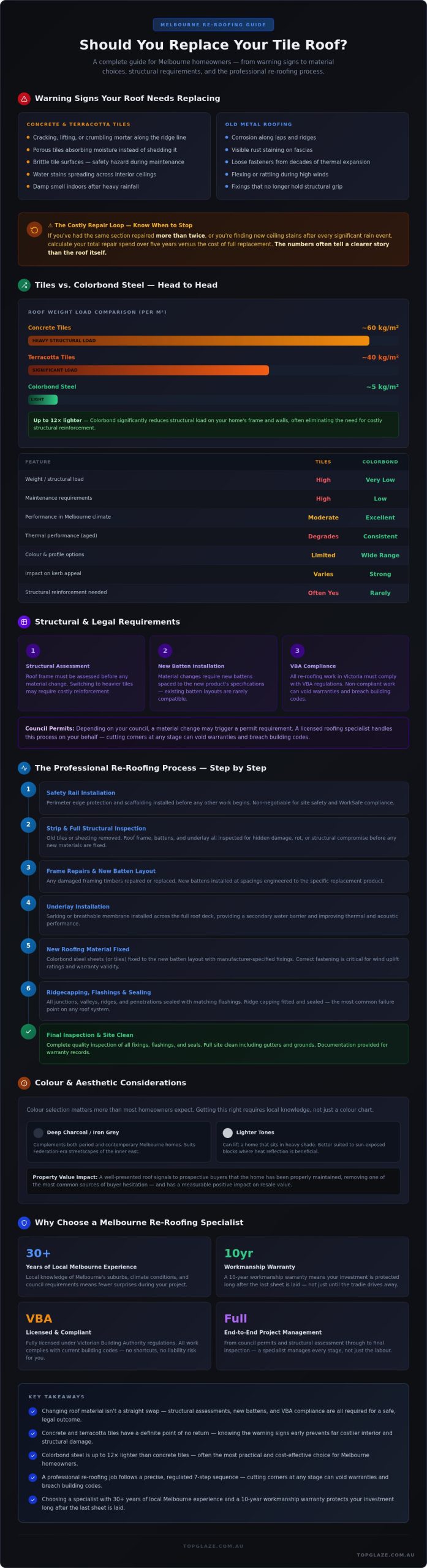
Colorbond steel has earned its dominant position for practical reasons. The weight difference alone is significant. A standard concrete tile system can place a load of around 40 to 50 kilograms per square metre on your roof structure, while a Colorbond sheet system typically comes in well under 10 kilograms per square metre. That reduction in dead load has structural implications that flow through the entire frame of the house, and it’s one of the primary reasons changing roof materials from tile to metal is so appealing for older Melbourne homes where the framing has already been carrying that load for decades.
Tiles do retain genuine advantages worth acknowledging. Terracotta and concrete both offer meaningful thermal mass, absorbing heat slowly during the day and releasing it gradually at night. They also provide better acoustic insulation against rain noise in their raw form, which is a consideration for homes in areas prone to heavy downpours. Neither benefit disappears entirely when you switch to metal, but they do need to be actively addressed through good installation practice rather than assumed.
The Tile-to-Metal Transition
Colorbond is the preferred choice for material swaps across Victoria for reasons that go beyond aesthetics. It’s manufactured to meet Australian standards for wind uplift and corrosion resistance, and its lightweight nature means the structural modifications required during a re-roofing project are typically less extensive than switching to an alternative heavy system. The rain noise concern is real but entirely manageable. High-quality sarking installed beneath the sheeting, combined with appropriate insulation batts, brings acoustic performance to a level most homeowners find entirely acceptable. Speed of installation is another genuine benefit; a metal re-roofing project on a standard Melbourne suburban home can often be completed in a fraction of the time required for a tile installation.
Choosing Your New Roof Colour and Profile
Colour selection carries more practical weight than many homeowners expect. Darker tones like Monument and Ironstone absorb more solar radiation, which can increase heat load in the roof space during summer unless adequate insulation and ventilation are in place. Lighter tones such as Classic Cream or Surfmist reflect more radiant heat, which can make a measurable difference to internal comfort during Melbourne’s peak summer months. Profile choice is equally important: low-pitched roofs suit broader, flatter profiles, while steeper pitches can carry more traditional corrugated or ribbed profiles that complement period architecture.
For Melbourne homes specifically, hail resistance is a factor that deserves direct attention. Colorbond steel in standard residential gauges performs well against moderate hail events, while aged or porous tiles can crack or shatter under the same conditions, creating immediate leak risk. If your home sits in areas that experience more frequent storm activity, this performance difference is worth factoring into your material decision.
Getting the combination of colour, profile, and insulation right requires more than browsing a brochure. A specialist with genuine local knowledge, like the team at Top Glaze roofing Melbourne, can assess your home’s specific pitch, orientation, and architectural character before making a recommendation you’ll be satisfied with for decades.
Structural and Legal Requirements for Changing a Roof
The structural side of changing roof materials is where many homeowners are caught off guard. The visual transformation is easy to picture; the engineering behind it is less obvious. Whether you’re moving from heavy tiles to lightweight metal or considering the reverse, what’s happening inside your roof frame matters just as much as what’s happening on top of it.
Engineering for Weight Changes
Switching from concrete or terracotta tiles to a metal sheet system removes a substantial load from your roof structure, which sounds straightforwardly positive. In practice, it introduces a different challenge: lightweight metal roofing is far more vulnerable to wind uplift than the heavy tile system it replaces. This is where tie-downs become critical. Tie-down straps or cyclone brackets are mechanical fixings that connect the roof sheeting and battens back through the rafters and into the wall frame, creating a continuous load path that resists the negative pressure generated during high-wind events. In Victoria, this isn’t optional; it’s a code requirement, and it must be correctly specified for your roof’s pitch, span, and local wind classification.
The existing timber rafters also need careful assessment before any material change proceeds. Older Melbourne homes, particularly those built before the 1970s, often have framing that was sized specifically for the tile load it was carrying. Removing that load changes the structural dynamics of the frame. A qualified structural engineer or an experienced roofing specialist can assess whether the existing framing is adequate for the new system or whether any modifications are required. Going the other direction, from metal to tiles, almost always requires a formal engineering assessment, because adding significant dead load to a frame that wasn’t designed for it can have serious consequences.
Roof pitch compatibility is another factor that doesn’t always receive the attention it deserves. Metal sheet roofing systems have minimum pitch requirements that are specified by the manufacturer and governed by Australian Standards. Installing a profile below its minimum recommended pitch creates a real risk of water ingress at the laps, regardless of how well the installation is executed.
Permits and Compliance in Melbourne
A common misconception is that re-roofing is always a permit-free job. In Victoria, a building permit is generally required when changing roof materials, because the work involves structural elements and must comply with the National Construction Code. The Victorian Building Authority sets the framework, and a registered building practitioner must be involved in work that falls within regulated categories. Roof plumbing, which covers the installation of metal roofing, guttering, flashings, and drainage, is a licensed trade in Victoria, distinct from general building work. This matters enormously when you’re vetting contractors; a roofer without a current Roof Plumbing licence is not legally permitted to carry out this work.
Compliance documentation also has direct implications for your warranty. A 10-year workmanship warranty, like the one offered by Top Glaze, is only meaningful when the underlying work has been completed to code. If a future insurance claim or property sale reveals that the re-roofing was done without the required permits or by an unlicensed tradesperson, that warranty and your legal protections become difficult to enforce.
Heritage overlays add another layer of consideration for homeowners in suburbs like Fitzroy, Hawthorn, Malvern, and parts of the Mornington Peninsula. If your property sits within a heritage overlay, your local council may have specific requirements about the materials, colours, or profiles that are permissible. These overlays exist to preserve streetscape character, and they can affect both the permit process and your material choices. Checking your property’s overlay status through your council’s planning portal before committing to a material is a straightforward step that avoids costly surprises later.
- Tie-downs and wind uplift fixings are a code requirement in Victoria, not an optional upgrade.
- Structural engineering assessments are essential when adding load (metal to tile) and strongly advisable when removing it (tile to metal).
- Roof Plumbing is a licensed trade in Victoria; always verify your contractor holds a current licence before work begins.
- Building permits are typically required when changing roof materials; confirm requirements with your local council or a registered building practitioner.
- Heritage overlays in specific Melbourne suburbs can restrict material and colour choices; check your planning certificate early in the process.
The Step-by-Step Process of a Professional Roof Change
Understanding exactly what happens on your property during a re-roofing project removes a great deal of the uncertainty that makes homeowners hesitant. A professional job follows a precise, regulated sequence, and every stage exists for a reason. Cutting corners at any point doesn’t just compromise quality; it can void manufacturer warranties, breach building codes, and create problems that don’t surface until years later.
Preparation and Safety
Before a single tile is touched, the site needs to be properly set up. Edge protection and safety rails are installed around the perimeter of the roof before any removal work begins. This isn’t optional formality; it’s a VBA compliance requirement, and a contractor who skips it is signalling something important about how they approach everything else on your job.
Protecting what’s below the roof line matters just as much. Drop sheets are laid over gardens, established plantings, and driveways before the removal phase begins. Old tiles are heavy and break on impact, and concrete fragments can cause real damage to paving, garden beds, and vehicle surfaces if the site isn’t properly managed. A well-organised crew works in a methodical pattern, clearing debris progressively rather than letting it accumulate.
Keeping your home watertight throughout the project is a genuine priority, not just a reassurance. On a standard Melbourne suburban home, the removal and re-sheeting phases are typically sequenced so that no large section of the roof deck is left exposed overnight. In the event of unexpected weather, temporary sarking or sheeting can be deployed quickly to protect the interior.
Once the old material is stripped, the roof structure gets its most thorough inspection in years. Damaged, split, or undersized battens are replaced at this stage, not papered over. Any rafter sections showing rot, insect damage, or structural fatigue are assessed and addressed before the new system goes on top. This is the step that separates a genuine re-roofing job from a surface-level material swap.
High-performance sarking is then laid across the full roof deck before any new sheeting is fixed. Sarking serves multiple functions simultaneously: it provides a secondary barrier against wind-driven rain, reduces condensation risk, and contributes meaningfully to the acoustic performance of the finished roof. Insulation batts are installed in the same phase, positioned to deliver thermal performance across Melbourne’s full seasonal range.
With the substrate prepared, the new roofing material is laid and fixed to specification, including all required tie-down fixings, before ridge capping is installed and pointed to a clean, weatherproof finish.
The Finishing Touches
A changing roof project isn’t complete when the last sheet goes down. New guttering and fascia are fitted to complement the new roof system, ensuring the full drainage line performs as a single, properly integrated unit. The site is then cleared completely, with all off-cut material, old tiles, and packaging removed and disposed of responsibly.
Handover includes your compliance documentation and workmanship warranty in writing. With Top Glaze, that means a 10-year workmanship warranty backed by more than 30 years of local Melbourne experience, giving you clear, documented protection long after the crew has packed up and left.
Ready to see what a properly sequenced re-roofing project looks like from start to finish? Talk to the Top Glaze team about your roof replacement and get a clear picture of what’s involved before you commit to anything.
Why Choose a Trusted Veteran for Your Melbourne Re-Roof
There’s a meaningful difference between a contractor who has been in business for a few years and one who has spent more than three decades working on Melbourne roofs specifically. Top Glaze brings that depth of local experience to every project, whether it’s a tile-to-metal conversion in an inner eastern suburb or a full replacement on the Mornington Peninsula. That kind of track record isn’t marketing language; it’s the accumulated knowledge of having seen what Melbourne’s weather, soil movement, and building stock actually do to roofing systems over time.
Changing roof materials is a significant investment, and the quality of the outcome depends almost entirely on who’s doing the work. Top Glaze’s 10-year workmanship warranty reflects a straightforward commitment: the job is done correctly the first time, and if anything related to workmanship falls short within that period, it’s made right. That warranty is only possible because the underlying standards are consistently met, from the structural preparation through to the final fix.
The Value of Seasoned Authority
Experienced roofers don’t just install material; they read a roof. Before a single tile is lifted, a Top Glaze specialist will identify the kinds of structural issues that a less experienced eye would miss: undersized rafters, compromised sarking from a previous repair, or batten spacing that doesn’t suit the profile being installed. Catching these issues at assessment stage, rather than mid-project, keeps timelines predictable and costs controlled.
Every project uses premium Australian-made materials, including Colorbond steel manufactured to meet Australian Standards for wind uplift and corrosion resistance. And the process is managed end-to-end, from navigating council permit requirements through to complete site clean-up. You’re not left to coordinate separate trades or chase paperwork. One specialist team handles the full scope.
- 30+ years of local Melbourne and Mornington Peninsula experience
- 10-year workmanship warranty on residential projects
- Specialists in both tile and Colorbond metal roofing systems
- Licensed and insured, with full compliance documentation provided
- Complete project management, from permits to final clean-up
Next Steps: Getting Your Professional Assessment
A Top Glaze on-site inspection covers the full picture: roof structure, existing material condition, pitch compatibility, drainage performance, and any heritage or council overlay considerations relevant to your property. You’ll receive a transparent, itemised quote with no hidden costs added later. No vague estimates, no surprises when the invoice arrives.
If you’re ready to stop putting off a decision that only gets more expensive with time, the next step is straightforward. Organise your free Melbourne roof assessment with Top Glaze today and get a clear, honest picture of what your changing roof project actually involves before you commit to anything.
Your Melbourne Roof Deserves a Fresh Start
Changing roof materials is one of the most significant home improvement decisions you’ll make, and getting it right comes down to three things: understanding when your current system has genuinely reached its limit, choosing a material that suits your home’s structure and Melbourne’s climate, and working with a specialist who knows how to execute the job to code.
The key points from this guide are straightforward. A material swap involves real structural and legal requirements that can’t be shortcut. The process follows a precise sequence for good reason. And the contractor you choose determines the quality of everything that follows.
Top Glaze brings 30+ years of local Melbourne experience, licensed roof plumbers and tilers, and a 10-year workmanship warranty to every residential project. That’s not a promise lightly made; it’s a reflection of consistently high standards across thousands of completed roofs.
Don’t let a deteriorating roof quietly cost you more than it should. Get a free quote for your Melbourne roof change with Top Glaze today and take the first step with complete confidence.
Frequently Asked Questions About Changing Your Roof in Melbourne
How much does it cost to change a roof in Melbourne?
Roof replacement costs vary considerably depending on your home’s size, the material you’re switching to, the condition of the existing structure, and whether any framing repairs are needed before the new system goes on. Every property presents a different set of variables, which is why a transparent, itemised quote based on an on-site assessment is the only reliable way to understand what your specific project will involve.
Be cautious of any contractor who quotes a firm price without inspecting the roof in person. Hidden structural issues discovered mid-project are a common source of unexpected costs, and a thorough assessment upfront is what keeps your budget predictable from start to finish.
Can I change my tile roof to Colorbond metal?
Yes, changing your tile roof to Colorbond metal is entirely achievable and is one of the most common re-roofing projects across Melbourne’s residential suburbs. The process involves removing the existing tiles, inspecting and replacing damaged battens, installing sarking and insulation, then fixing the new Colorbond sheeting with the required tie-down fixings to meet Victorian wind uplift requirements.
The key is ensuring your roof’s pitch meets the minimum requirements for the profile you’ve chosen and that the structural framing is assessed before work begins. A specialist with experience in tile-to-metal conversions will identify any compatibility issues at the inspection stage, well before they can affect your timeline or budget.
How long does a full roof replacement usually take?
On a standard Melbourne suburban home, a full Colorbond re-roofing project typically takes between two and four days from setup through to final clean-up, depending on the home’s size, roof complexity, and the extent of any structural repairs required. Tile installations generally take longer due to the additional labour involved in laying individual units.
Weather is always a factor in Melbourne, and experienced crews plan their sequencing to minimise the time any section of roof is left exposed. A well-organised team will give you a realistic timeline at the quoting stage and keep you informed if conditions require any adjustments.
Do I need council approval to change my roof material in Victoria?
In most cases, yes. Changing roof materials in Victoria typically requires a building permit because the work involves structural elements that must comply with the National Construction Code. Roof plumbing is also a licensed trade in Victoria, meaning the contractor carrying out the work must hold a current licence issued under the relevant state legislation.
If your property sits within a heritage overlay, your local council may also have specific requirements about permissible materials, colours, or profiles. Checking your planning certificate early and working with a licensed specialist who understands the permit process is the straightforward way to ensure your project is fully compliant from the outset.
Is a metal roof noisier than a tile roof during Melbourne rain?
Rain noise is a genuine consideration, but it’s one that good installation practice addresses directly. High-performance sarking laid beneath the sheeting, combined with quality insulation batts installed in the roof space, brings acoustic performance to a level most homeowners find entirely acceptable in everyday conditions, including Melbourne’s heavier downpours.
The difference between a noisy metal roof and a quiet one almost always comes down to whether the insulation and sarking were installed properly. Skimping on this stage to reduce upfront costs is a false economy that becomes apparent on the first wet night.
Will changing my roof material increase my home value?
A professionally executed roof replacement consistently removes one of the most significant sources of buyer hesitation during property inspections. A new, well-presented roof signals that the home has been properly maintained, and that reassurance has a measurable effect on buyer confidence and, in turn, on the offers a property attracts.
The uplift isn’t purely cosmetic. Buyers and their building inspectors know that a deteriorating roof represents deferred expenditure. Removing that concern from the equation, particularly with a material like Colorbond that carries a strong reputation for longevity, positions your home more favourably in Melbourne’s competitive residential market.
What happens if it rains while my roof is being changed?
Experienced roofing crews plan their sequencing specifically to manage this risk. On a standard project, removal and re-sheeting are staged so that no large section of the roof deck is left exposed overnight. If unexpected weather moves in during the working day, temporary sarking or sheeting can be deployed quickly to protect the interior.
Before work begins, your contractor should walk you through their wet weather protocol so you understand exactly how your home will be protected at every stage. A crew that can’t answer this question clearly is one worth reconsidering before you commit.
Does Top Glaze provide a warranty on the new roof?
Yes. Top Glaze provides a 10-year workmanship warranty on residential roofing projects. This covers the quality of the installation itself and reflects a straightforward commitment: the job is done correctly the first time, and any workmanship-related issue that arises within that period will be made right.
It’s worth noting that a workmanship warranty is only as meaningful as the standards behind it. Top Glaze’s warranty is backed by over 30 years of local Melbourne experience, licensed tradespeople, and the use of premium Australian-made materials, which means the conditions that make a warranty claimable are consistently avoided in the first place.


