

What if the very system designed to protect your home from a Melbourne downpour is actually the biggest threat to your living room ceiling? It is a stressful realisation many local homeowners face when they discover that box guttering, unlike standard eaves gutters, sits within the roof’s footprint and can cause significant internal damage if it fails. You aren’t alone if you feel confused about why your drainage is so complex or why finding a contractor who truly understands these high-stakes systems feels like a gamble.
We believe you deserve the peace of mind that comes with a dry, secure home. This guide will teach you how to identify structural risks early and choose the right replacement materials to prevent internal flooding. We will also walk you through the latest 2026 Victorian building regulations and the mandatory AS/NZS 3500.3 design standards to ensure your next repair or replacement is a permanent solution that protects your property for years to come.
Key Takeaways
- Understand why box guttering is concealed within your roofline and why this unique design creates a higher risk of internal water damage compared to standard eaves gutters.
- Learn how to spot the specific warning signs of failure before a major storm leads to costly internal flooding.
- Establish a reliable maintenance routine that includes bi-annual professional inspections to prevent debris buildup and blockages.
- Discover why custom-folded materials and adherence to the latest 2026 Victorian building standards are essential for a permanent repair.
- Gain peace of mind by understanding how a 10-year warranty on licensed workmanship protects your home’s value and safety.
What is Box Guttering and How Does it Protect Your Home?
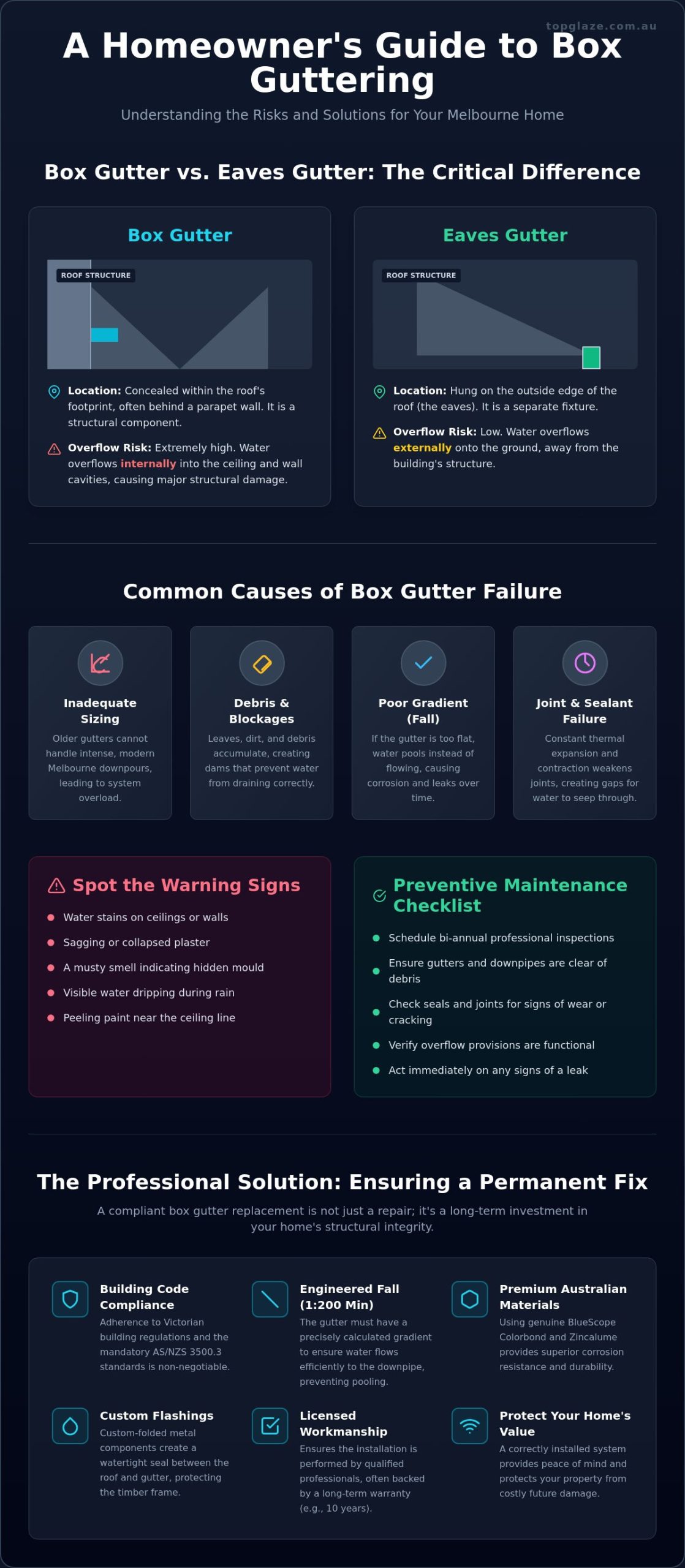
When you walk through many Melbourne suburbs, you’ll notice that modern homes often have a sleek, seamless look where the roof seems to disappear behind the walls. This aesthetic is made possible by a specific drainage system. To understand what is a box gutter, you have to look past the external walls. Unlike standard eaves gutters that hang off the edge of your roof, box guttering is a rectangular channel concealed within the building’s perimeter. It’s literally “boxed” into the roof structure, often sitting between two roof slopes or tucked behind a decorative parapet wall.
Because these gutters are integrated into the home’s footprint, they aren’t just a plumbing fixture; they’re a structural component. This “internal” factor is what makes them so unique. If a standard gutter overflows, the water usually spills onto the grass. If a box gutter fails, the water is already inside your building’s envelope, meaning it can head straight for your ceiling and wall cavities. This high-stakes environment is why we only use premium Australian materials like genuine BlueScope Colorbond and Zincalume. These materials are the industry standard for a reason. They offer the specific corrosion resistance and durability needed to protect a Melbourne home from our unpredictable storm cycles.
The Mechanics of Internal Drainage
A box gutter acts as a high-volume collector. It often receives heavy water flow from multiple roof valleys simultaneously, directing it toward a central downpipe. For this system to function safely, the “fall” or gradient must be perfectly calculated. If the gutter is too flat, water pools, leading to premature rust and blockages. We ensure every installation meets the mandatory 1:200 minimum fall required by current standards. We also focus heavily on custom flashings. These metal components bridge the gap between your roof and the gutter, creating a watertight seal that keeps moisture away from your timber frame.
Why Modern Melbourne Architecture Favours Box Gutters
Architects across Melbourne frequently choose these systems for their versatility and clean lines. They are the go-to solution for contemporary designs that require a “hidden roof” look. Beyond aesthetics, they are a practical necessity for zero-lot-line properties. When a house is built right up to the boundary, there is no room for eaves to overhang a neighbour’s fence. In these tight spaces, a box gutter integrated with a parapet wall provides a compliant, efficient way to manage stormwater. It’s a sophisticated design choice that works beautifully, provided it’s installed by someone who understands the complexities of internal drainage.
Why Box Gutters Fail: Common Issues and Structural Risks
While standard gutters are visible and easy to monitor from the garden, the hidden nature of box guttering means that when things go wrong, they often go wrong spectacularly. The most significant risk is that these systems are designed to fail “inward”. If a blockage occurs or the capacity is exceeded during a sudden Melbourne storm, the water has nowhere to go but into your ceiling cavity. This isn’t just a minor damp patch; it can lead to collapsed plaster, ruined insulation, and structural timber rot that compromises the safety of your home.
Many older Melbourne homes suffer from inadequate sizing. As weather patterns become more volatile, box guttering designed decades ago simply can’t cope with the volume of water from modern downpours. This technical challenge is explored in detail in this AHSCA technical paper on box gutter design, which highlights how precise engineering is required to meet current Australian Standards. Beyond sizing, thermal expansion plays a massive role. In a city where the temperature can swing 20 degrees in a single afternoon, the metal in your gutters expands and contracts constantly. This movement puts immense stress on joints and sealants, eventually creating gaps that allow water to seep through.
The Danger of Internal Overflow
A blocked box gutter is a ticking clock. Because they are often wider and deeper than eaves gutters, they collect more debris, but that debris is harder to see from the ground. Without functional overflows or sumps, a “silent leak” can persist for months before you notice a stain on the ceiling. By then, mould has likely taken hold in the roof space. We often find that a professional roof inspection can catch these issues before they turn into a full-scale emergency, saving you thousands in internal repairs.
Corrosion and Joint Failure
Water should never sit still in your gutters. When water “ponds” due to incorrect fall, it eats away at the protective coating of Zincalume or Colorbond, leading to premature rust. We also see many failures caused by mismatched metals. If an aluminium flashing is paired with a steel gutter without proper insulation, galvanic corrosion occurs, effectively dissolving the metal at the contact point. Modern techniques using high-grade sealants and specific riveting patterns have replaced old, brittle solder joints, providing a much more flexible and durable finish for the Australian climate.
Box Gutters vs. Eaves Gutters: Which System Does Your Roof Need?
Choosing the right drainage system for your home usually comes down to two factors: architectural style and risk appetite. Most Melbourne residents are familiar with eaves gutters. These are the visible channels, like quad or half-round profiles, that attach to the fascia boards around the perimeter of the roof. In contrast, box guttering is an integrated system that stays hidden from view. While both serve the same primary purpose of moving water away from your foundations, the way they are designed and installed couldn’t be more different.
The visual impact is the most obvious differentiator. Eaves gutters are a prominent feature of a home’s exterior, often used to add a pop of colour or define the roofline. Box gutters, however, are preferred by those seeking a minimalist, contemporary aesthetic. They allow for clean lines and parapet walls that would be impossible with traditional external guttering. However, this beauty comes with a trade-off in installation complexity. Eaves gutters are relatively straightforward to install using mass-produced components. Box gutters require precise roof plumbing and custom fabrication. Because they must be folded to fit the specific dimensions of your roof’s internal channel, they represent a higher initial investment in both materials and skilled labour.
Pros and Cons of Box Guttering
- Pro: Provides a sleek, high-end finish for modern designs and multi-pitch roofs.
- Pro: Capable of managing massive volumes of water by funneling flow from multiple valleys into a single, wide channel.
- Con: Higher risk of internal flooding. If the system is neglected, water overflows into the house rather than onto the garden.
- Con: More expensive to replace. The need for custom-folded BlueScope steel and expert fitting increases the project cost compared to off-the-shelf eaves profiles.
When to Choose Eaves Gutters Instead
For a standard residential home with overhanging eaves, traditional external gutters are often the most practical choice. They offer a “set and forget” factor that box gutters simply cannot match. If an eaves gutter becomes blocked, the water usually spills over the front of the gutter, safely away from the internal structure of the home. This makes them far more forgiving for homeowners who prefer to handle their own basic maintenance. Access is also much simpler; you can usually clear an eaves gutter with a ladder and a bucket without having to navigate complex roof valleys or walk on fragile internal channels. If your priority is low-risk drainage and ease of access, eaves gutters remain the reliable suburban standard.
Maintaining Your Box Guttering: A Preventive Checklist
A box gutter is not a “fit and forget” system. Because these channels are tucked inside your roof structure, they demand a more rigorous maintenance schedule than standard eaves gutters to ensure your home remains watertight. Neglecting this part of your roof is the fastest way to invite the internal flooding we discussed earlier. We recommend scheduling a professional inspection at least twice a year, ideally before the heavy autumn leaf fall and again before the peak of the summer storm season. This ensures that any minor issues are caught before they become expensive structural problems.
Your maintenance routine should be proactive rather than reactive. If your home is surrounded by overhanging trees, you should clear debris monthly. Even a small handful of leaves can restrict the flow in a high-volume system. During these cleanings, look for “ponding” water. If you see stagnant pools after the rain has stopped, it indicates that the gutter fall has shifted or the metal has buckled, requiring immediate adjustment to restore the 1:200 gradient. You should also closely inspect the flashings and sealants. Over time, the intense Melbourne sun causes these materials to crack or lift, creating entry points for moisture that bypasses the box guttering entirely.
The Importance of Leaf Protection
Standard, off-the-shelf leaf guards often fail in box gutters because they aren’t designed for the sheer volume of water these systems handle. A poorly fitted guard can actually trap debris inside the channel, making the problem worse. We specialise in customised screening solutions that keep sumps and downpipes clear without restricting water flow. When we perform box guttering repairs, we often integrate a high-quality Leaf Guard system to provide a secondary layer of defence, giving you long-term peace of mind and reducing the frequency of manual clean-outs.
Signs You Need an Immediate Repair
You don’t always need to climb a ladder to know there’s a problem. Keep a sharp eye out for these red flags inside and outside your home:
- Internal damp spots: Any discolouration or bubbling paint on your ceilings or high on your internal walls.
- Surface rust: Visible orange staining or “bubbling” on the metal surface of the gutter itself.
- External water marks: Dark streaks or dampness on the underside of your roof eaves or fascia boards.
If you notice any of these signs, the “silent leak” has likely already started. Acting quickly can mean the difference between a simple sealant touch-up and a full-scale ceiling replacement. If you’re concerned about the state of your drainage, you can book a professional roof repair assessment to identify and resolve these risks before the next downpour.
Professional Box Gutter Replacement: The Top Glaze Approach
When repairs and maintenance are no longer enough to guarantee a dry home, a professional replacement is the only way to secure your property’s future. Box guttering is not a product you can simply pick up from a hardware store and install yourself. Because every Melbourne home has its own unique roof pitch and architectural quirks, custom-folding is an absolute necessity. We don’t believe in one-size-fits-all solutions. Our team takes precise measurements on-site to ensure every millimetre of your new drainage system is tailored to fit your roof’s specific profile perfectly.
We exclusively use premium BlueScope Colorbond steel for our replacements. This isn’t just about superior weather resistance; it’s about ensuring your new gutters match the existing aesthetic of your home. Colorbond is designed to withstand the harsh Victorian sun and heavy rainfall without peeling or cracking. By combining these high-grade materials with the expertise of our licensed roof plumbers, we ensure that your new system has the correct fall and the overflow capacity required to meet current safety standards. This methodical approach removes the anxiety of future leaks and provides the stability your home deserves.
Our Step-by-Step Replacement Process
Our replacement method is thorough and logical, designed to solve problems at their source. We begin with a comprehensive site assessment to identify why the previous system failed. Once we’ve custom-measured the profiles, we move to the safe removal of old, rusted materials. This stage is critical. It allows us to inspect the underlying timber fascia and structural supports for any hidden rot or water damage that needs addressing before the new metal is laid. We then install high-capacity sumps and modern overflow systems. These components act as a vital fail-safe, directing water safely away from your internal cavities even during the most extreme weather events.
Why Melbourne Homeowners Trust Top Glaze
With 30 years of experience managing complex residential roof restoration projects across Melbourne, we’ve encountered every possible drainage challenge. We are a local, family-owned business, and we deeply understand how Victorian weather patterns can stress a building’s structure. This local presence allows us to provide a sense of stability and neighborly reassurance that larger, distant corporations simply can’t match. We carry ourselves as a pillar of the local industry, focusing on quality and reputation.
We value transparency and long-term relationships over quick wins. That’s why we provide clear, upfront quoting with no hidden costs for structural repairs. Every residential project we undertake is backed by a 10-year warranty on our licensed workmanship. This isn’t just a promise; it’s our commitment to your peace of mind. When you choose us for your guttering and fascia needs, you’re investing in a permanent solution that protects your home for the long haul.
Secure Your Home Against Melbourne’s Unpredictable Weather
Managing your roof’s drainage doesn’t have to be a source of constant anxiety. By understanding the unique structural requirements of box guttering, you’ve already taken the first step toward protecting your home’s interior from water damage. Prioritising correct fall gradients and high-quality materials like Colorbond will ensure your drainage remains a silent, reliable protector for decades to come. It’s about shifting from reactive repairs to proactive stability.
We’ve spent over 30 years helping more than 20,000 Melbourne homeowners find permanent solutions for their roofing challenges. Our licensed roof plumbers understand exactly what it takes to navigate Victorian building standards and complex drainage designs. When you’re ready for true peace of mind, we’re here to help with a 10-year warranty on all residential projects. Get a Professional Box Gutter Assessment from Top Glaze Today and rest easy knowing your home is in expert hands. You deserve a roof that stands the test of time and weather.
Frequently Asked Questions
How much does box guttering replacement cost in Melbourne?
Replacement costs vary based on the total length, the complexity of your roof’s geometry, and the material selected. Because box guttering requires custom folding to fit your specific roof channel, it’s a more involved process than standard eaves guttering. We recommend getting a professional assessment to understand the specific requirements of your home, as factors like access and the condition of underlying timbers will also influence the final investment.
Can I replace a box gutter myself or do I need a roof plumber?
You should always use a licensed roof plumber for this type of work. In Victoria, box gutters are considered high-risk because they sit within the building’s footprint. A licensed professional ensures the installation meets the strict AS/NZS 3500.3 standards and can provide a compliance certificate. Attempting a DIY replacement often leads to incorrect fall or inadequate overflow provisions, which can result in devastating internal flooding during the next storm.
How long do Colorbond box gutters typically last?
A high-quality Colorbond system will typically last 20 years or more when maintained correctly. The longevity of your gutters depends heavily on the environment, such as proximity to the coast or overhanging trees. We use premium Australian-made steel to ensure maximum durability against Melbourne’s harsh sun and rain. Regular inspections and clearing debris are the best ways to ensure your system reaches its full lifespan without developing premature rust or joint failure.
What is the best way to clean a box gutter safely?
The safest way to clean these gutters is from a stable ladder or by hiring a professional who can navigate your roof safely. You should focus on removing all organic matter from the channel and ensuring the sumps and downpipe entries are completely clear. Because box gutters are often wider and concealed, it’s easy to miss debris that has settled in the corners. Always use a scoop rather than a high-pressure hose, which can inadvertently force water under your flashings.
Why is my box gutter overflowing even when it isn’t blocked?
Overflows often happen because the gutter is undersized for modern rainfall intensities or the “fall” is incorrect. Even if there are no leaves, if the gradient isn’t at least 1:200, water will pool and eventually spill over the sides during a heavy downpour. Many older Melbourne homes have gutters that were designed for lower rain volumes. If your system struggles during intense storms, it may require a larger custom-folded profile or additional overflow devices to handle the surge.
Are box gutters more likely to leak than regular gutters?
Box gutters aren’t necessarily more prone to leaking, but the consequences of a leak are far more severe. While a regular eaves gutter leaks outside onto your garden, a box gutter leak occurs directly above your ceilings. This design makes them “high-stakes” infrastructure. Because they are integrated into the roof, they also face more stress from thermal expansion and contraction, which can wear down sealants and joints faster than external systems if not installed with precision.
What size should my box gutter be to handle heavy rain?
Residential box gutters must have a minimum sole width of 200mm according to Australian Standards. The exact depth and width required for your home depend on the total catchment area of your roof and the expected rainfall intensity in your part of Melbourne. Our licensed plumbers calculate these dimensions using AS/NZS 3500.3 to ensure your system can safely divert water away from your home during a 1-in-100-year storm event.
Do I need a permit for gutter replacement in Victoria?
While you don’t typically need a standard building permit for a simple replacement, the work must be performed by a licensed plumber who can issue a compliance certificate. In Victoria, any plumbing work valued over $750 requires this certification to prove the installation meets current regulations. This document is essential for your insurance and provides peace of mind that the box guttering was installed by a qualified expert who follows the latest Building and Plumbing Commission guidelines.


