

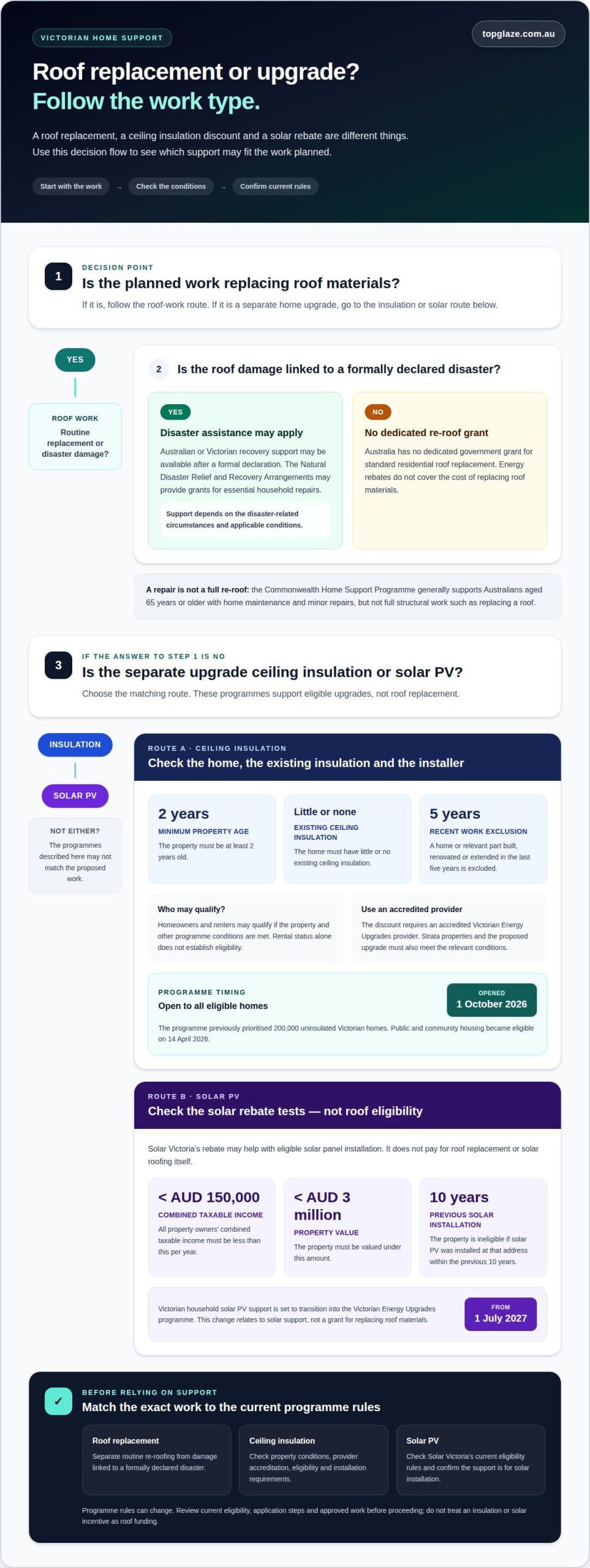
There are no dedicated government grants for standard residential roof replacement in Australia, so government rebates for roof replacement Victoria won’t cover a typical re-roof. Assistance may be available for damage caused by a formally declared disaster. Other Victorian programs support separate upgrades, such as ceiling insulation or solar.
It’s understandable to look for help with a major home expense, especially when a roof needs attention. Government rebates for roof replacement Victoria depend on the type of work: replacing the roof is different from installing a separate eligible upgrade.
This guide explains how households, rental property owners and strata properties may qualify for relevant assistance, where to find information about Victorian programs, and what to know about possible changes. It also outlines the factors that affect roof replacement projects in Melbourne, so you can assess your options before planning the work.
Key Takeaways
- Separate roof replacement from energy upgrades and disaster assistance to see which support may fit your situation.
- Household, rental and strata eligibility can differ, so the type of property and the work planned matter.
- Victorian programs can change over time; knowing where to check helps you avoid relying on outdated rebate details.
- Melbourne replacement costs depend on the roof and scope of work, so itemised quotes help clarify what a project involves.
Eligibility for households, rental owners and strata properties
Eligibility depends on the upgrade, property and applicant. Energy rebates generally support specific improvements, not the cost of replacing a roof.
Household and Victorian property eligibility
Victorian home energy upgrade eligibility depends on the program’s property and installation rules. For the ceiling insulation discount, a property must be at least 2 years old and have little or no existing ceiling insulation. Homeowners and renters may qualify, subject to the other conditions, while a home or relevant part built, renovated or extended in the last five years is excluded.
Solar PV has separate tests: according to Solar Victoria, all property owners’ combined taxable income must be less than AUD 150,000 per year, and the property must be valued under AUD 3 million. These thresholds concern the solar rebate, not roof replacement or solar roofing itself.
Programme eligibility and scope
The Commonwealth Home Support Programme generally supports Australians aged 65 years or older, according to the Australian Government Department of Health, Disability and Ageing. It can assist with home maintenance and minor repairs, but not full structural work such as replacing a roof. That distinction matters: support for a small repair does not make a full re-roof eligible.
Eligible energy upgrades must be installed by accredited installers. The Victorian ceiling insulation discount also requires an accredited Victorian Energy Upgrades provider. Owners and renters may qualify for insulation support if the property meets the program’s conditions. Rental status alone does not establish eligibility.
Victoria’s solar PV rebate may help with eligible solar panel installation, not the roof replacement cost. A property is also ineligible if solar PV was installed at that address within the previous 10 years.
The rebate programs described here set eligibility for insulation or solar PV, not roof-replacement permits, construction standards or site-safety requirements. These are separate from the conditions for qualifying for an energy upgrade.
Australia has no dedicated government grant specifically for residential roof replacement. Federal or Victorian assistance may be available after a formally declared disaster, while the Commonwealth Home Support Programme excludes full structural roof work.
Before relying on a rebate, match the proposed work to the program. Insulation and solar PV are separate from replacing roof materials. For strata properties, both the upgrade and property must meet the relevant program conditions.
Checking current Victorian government programs
Victorian assistance is tied to specific work, so start by matching the program to the proposed upgrade. Roof replacement, ceiling insulation and solar PV are separate projects, even when planned for the same home. Australia has no dedicated government grant specifically for residential roof replacement. This distinction helps avoid mistaking an insulation or solar incentive for roof funding.
For current details, check the relevant program’s official information before making decisions. Solar Victoria publishes the eligibility rules for its solar PV rebate. For ceiling insulation, look for Victorian Energy Upgrades program information, including provider accreditation, property conditions and how the discount is applied. Public and community housing became eligible for the insulation program on 14 April 2026. The discount opened to all eligible homes on 1 October 2026.
Use a short assessment to sort the options:
- Roof work: Identify whether the need is routine replacement or damage linked to a declared disaster.
- Energy upgrade: Separate ceiling insulation from solar PV, then match the eligible home and proposed installation to that program’s rules.
- Disaster assistance: Check whether a formal disaster declaration applies and whether recovery support covers the circumstances.
Victorian and Australian government programs may provide disaster recovery assistance for roof damage after a formal declaration. The Natural Disaster Relief and Recovery Arrangements may provide grants for essential household repairs following an officially declared disaster. This assistance is different from general rebates and depends on disaster-related conditions.
Program rules can change, so note the page’s publication or update date and review the eligibility, application process and approved work before proceeding. From 1 July 2027, Victorian household solar PV support is set to transition into the Victorian Energy Upgrades program. That change concerns solar support, not a grant for replacing roof materials. Checking the program name and eligible work side by side makes it easier to distinguish useful assistance from unrelated incentives.
Expected rebate launch timing
The Victorian ceiling insulation discount is already open, rather than awaiting a future launch. It opened to all eligible homes on 1 October 2026, following an earlier priority for 200,000 uninsulated Victorian homes. That timing matters if you’re planning an energy efficiency upgrade: check the current program conditions, not older launch estimates.
The discount applies to ceiling insulation, not replacement roof materials. The final discount depends on the eligible installation and the program’s assessment.
Installation has specific timing requirements. The electrical safety assessment must occur within 30 days before installation and at least 24 hours beforehand. A homeowner must also sign the rebate consent form at least 24 hours before insulation work starts. These steps affect when the work can proceed, so they belong in the installation timeline.
- Before booking: Confirm the home meets the insulation program’s property conditions and use an accredited Victorian Energy Upgrades provider.
- Before installation: Complete the required electrical assessment and consent steps within their stated timeframes.
- For solar: Victorian household solar PV support is set to transition into the Victorian Energy Upgrades program from 1 July 2027.
The solar transition is a separate program change, not the launch of a roof replacement rebate. Similarly, the ceiling insulation discount’s dates don’t make roof replacement eligible. Match each planned upgrade to its own program and timing.
Victorian Energy Upgrades rules also address how offers reach households. Cold-call telemarketing for rebate insulation has been banned since 1 May 2024, and doorknocking to offer it has been banned since 1 August 2024. A clear timeline should therefore focus on eligibility, assessment, consent and installation, rather than unsolicited offers.
Residential roof replacement costs in Melbourne
For Melbourne homeowners, a useful starting point is understanding what shapes a roof replacement quote. The price depends on the project and is provided in a quote. Roof size, material, access, condition and required work all affect the scope. A straightforward roof and a complex one won’t have identical requirements.
Look closely at the work included, not just the total. An itemised quote can show whether it covers removing existing materials, replacement materials, disposal and related roof work. If an inspection identifies damaged sections or other issues, these can change the scope. A clear breakdown shows what each part of the project covers.
Several practical details influence the assessment:
- Roof area and shape: Larger or more complex roof surfaces can require different quantities and installation work.
- Material choice: Tile and metal roofs involve different materials and work requirements.
- Access and condition: The roof’s accessibility and existing state affect the work needed.
- Related work: Guttering, fascia or repairs may form part of a broader property-maintenance plan.
Keep energy upgrades separate from roofing costs. Victorian insulation rebates apply to eligible ceiling insulation, not replacement roof materials. If you’re planning both projects, treat them as separate scopes and assess each against its own program conditions. Eligible Victorian Energy Upgrades insulation installations require an accredited provider.
For a practical next step, request an itemised assessment of the roof replacement work. It helps establish which materials and tasks the project involves, without confusing an energy discount with roofing costs. To discuss the work involved at your property, request a roof replacement quote and outline the roof’s material, condition and any related concerns. That information gives the assessment a clear starting point for your Melbourne home.
Top Glaze Roofing Systems: Roof Replacement
Top Glaze Roofing Systems provides residential roof replacement when a roof needs work beyond what an eligible energy-upgrade rebate covers. If you’re weighing replacement against repair or restoration, the right scope depends on the roof’s condition and the work required. Repairs can address localised problems, while restoration may suit a roof that can be renewed rather than replaced. Guttering and fascia can also help protect the home.
A clear assessment helps distinguish roof work from separate ceiling insulation or solar programs, so you can plan each project on its own terms. If replacement is the practical next step, contact Top Glaze Roofing Systems to discuss your roof and the work involved.
Plan your next roofing decision with confidence
Before committing to roof work, separate the immediate problem from longer-term improvements. A leak or damaged section may need a different response from a roof nearing the end of its serviceable life. This distinction helps you explain the issue clearly and consider the appropriate scope of work.
Any government rebates for roof replacement in Victoria depend on the type of assistance and work involved, so keep government rebates for roof replacement in Victoria separate from incentives for energy upgrades. If your roof needs professional attention, contact Top Glaze Roofing Systems to discuss your needs. A considered decision starts with understanding the problem, and you can take that step at your own pace.
Frequently Asked Questions
Are There Any Government Grants for Roof Replacement in Victoria?
There are no dedicated government grants specifically for residential roof replacement in Victoria. Disaster recovery assistance may be available after a formally declared disaster, subject to conditions such as the home being your principal residence and the damage not being covered by insurance. Keep insurance information and records of the damage together, as these details may matter when assessing disaster-related assistance.
What government rebates am I eligible for?
Eligibility depends on the upgrade and property, not simply on being a Victorian household. Ceiling insulation support may suit an eligible home with little or no existing insulation, while solar PV rebates have separate income and property-value tests. An owner or renter may qualify for the described insulation discount if the other conditions are met. Check the program requirements against the proposed work.
What is the Victorian Energy Upgrades program?
The Victorian Energy Upgrades program provides incentives for eligible energy-efficiency improvements, including ceiling insulation in homes where insulation is absent or inadequate. An accredited provider applies the discount at installation, rather than the household claiming cash later. For example, a household planning a re-roof and insulation should treat them as separate works: the insulation incentive does not fund replacement roof materials.
What to Budget for a Residential Roof Replacement in Melbourne?
Budget for the specific work identified in an itemised quote, rather than assuming every Melbourne roof replacement has the same scope. Roof size, shape, material, access and condition affect the work required. Ask for the quote to separate the main replacement work from related items, such as guttering or fascia, so you can see what each part covers and plan accordingly.
What Victorian government rebates or grants are available for roof replacement?
For a typical residence, Victorian programs support eligible upgrades such as ceiling insulation or solar PV, not roof-material replacement. Disaster assistance may be available after a formal declaration. A separate Victorian Chinese community facility grant can fund structural repairs, including roofing, at an existing Chinese community facility. That grant applies to qualifying community facilities, not household roof replacement.
Do Victorian government rebates cover roof repairs, reroofing, or only energy-efficiency upgrades?
Most relevant household rebates described here relate to energy upgrades, not routine roof repairs or re-roofing. A repair linked to a formally declared disaster may qualify for disaster recovery assistance, depending on the circumstances and applicable conditions. For an ordinary leak or ageing roof, treat repair or replacement as roofing work, separate from any eligible insulation or solar upgrade.


