

The rock-solid cement sitting beneath your ridge tiles might look indestructible, but that very rigidity is often what invites water into your home. When Melbourne homeowners ask what is flexible pointing for ridge caps, they are usually dealing with a familiar frustration: hairline cracks along the roofline, crumbling mortar in the gutters, and the nagging worry of the next wild storm.
It’s completely understandable to feel anxious when you spot deterioration overhead, especially if you’re worried a few cracked caps will force a full, expensive roof replacement. Modern roofing methods offer a much more durable, practical solution. Unlike outdated sand-and-cement mixes, flexible pointing acts as an engineered polymer skin that flexes naturally with your home’s structural movement. In this 2026 guide, you’ll discover how modern flexible pointing protects your roof ridge caps from leaks, thermal movement, and costly storm damage. We’ll clarify the difference between structural bedding and pointing, show you how to identify early warning signs, and explain what compliant Australian Standards mean for your property.
Key Takeaways
- Understand what is flexible pointing for ridge caps and how its elastomeric polymer formula flexes with your roof rather than fracturing under seasonal temperature shifts.
- Learn the critical distinction between the structural sand-and-cement bedding beneath your ridge tiles and the waterproof pointing coat applied over the top.
- Identify early warning signs of mortar breakdown, such as dislodged rubble in your gutters and hairline fractures along the hips, before moisture penetrates the ceiling cavity.
- Discover the professional restoration process required to prepare, re-bed, and point ridge capping in full compliance with current Australian Standards.
What Is Flexible Pointing for Ridge Caps on Tile Roofs?
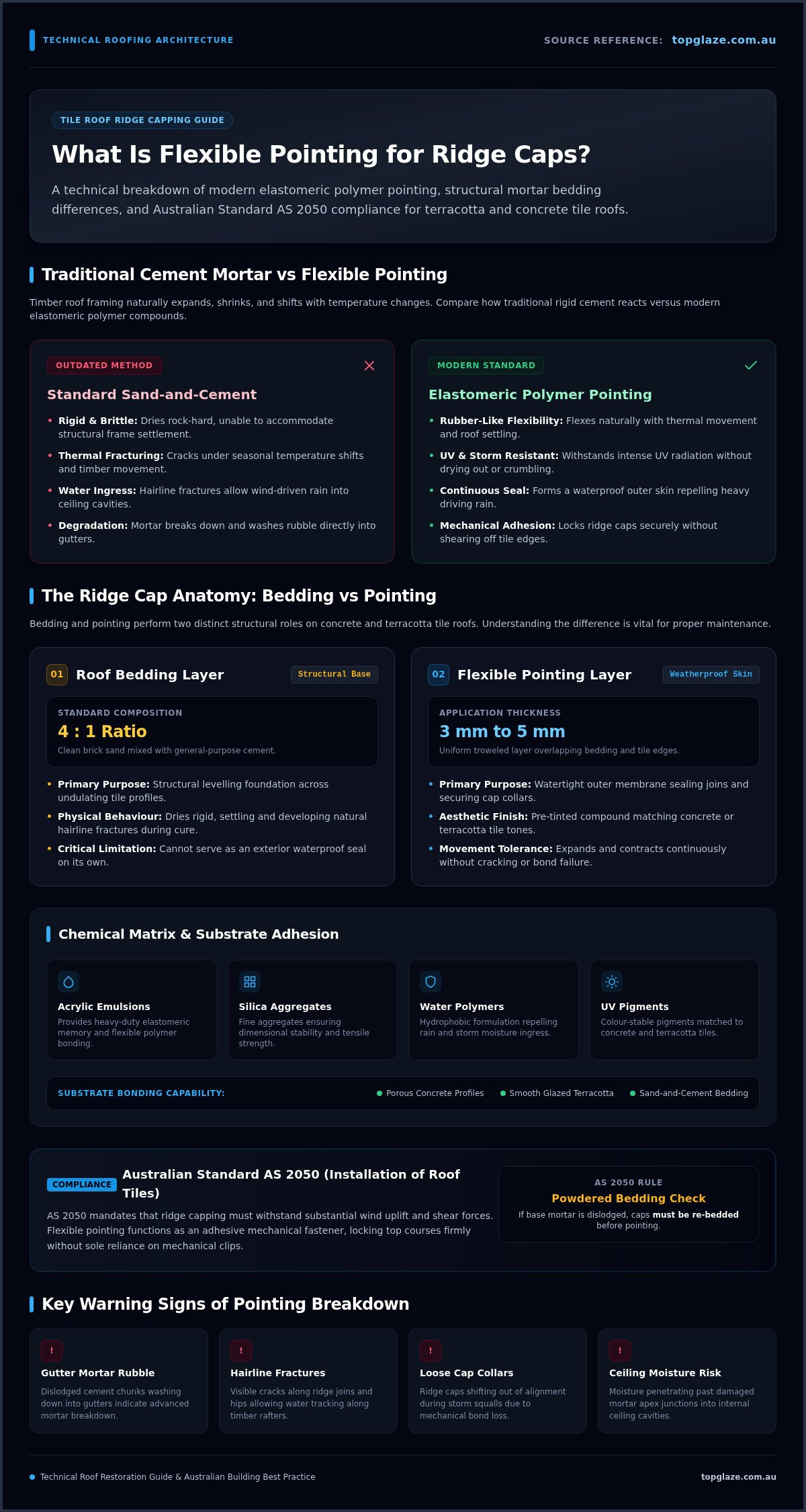
To understand what is flexible pointing for ridge caps, you first have to look at how modern building materials solve an age-old roofing vulnerability. In simple terms, flexible pointing is a factory-mixed, acrylic-polymer compound troweled along the joins of ridge and hip caps. While older roofing practices relied strictly on brittle cement mortar, this elastomeric compound forms a tough, waterproof outer skin that flexes effortlessly whenever your home settles or shifts.
Traditional cement dries rock-hard, but timber roof framing constantly swells, shrinks, and moves beneath it. Flexible pointing eliminates that structural tension. Engineered for both modern concrete profiles and traditional terracotta tiles, the advanced acrylic formula repels driving rain and withstands baking ultraviolet radiation without drying out, cracking, or crumbling away over time.
The Anatomical Role of Ridge Capping
Ridge caps sit along the roof apex where opposing roof slopes meet, capping off the highest lines of your home. Their primary duty is shielding vulnerable timber rafters, structural battens, and internal ceiling cavities from direct moisture ingress. When caps shift or mortar washes away, wind-driven rain tracks straight into the home.
Historically, builders treated these apex junctions as rigid masonry seams. Today, repointing deteriorated mortar joints with polymer compounds provides the necessary movement tolerance for modern construction. Properly pointed caps also mechanically secure the top courses of your roof tile roofing, locking the uppermost tiles firmly in position during severe storm squalls.
The Chemistry Behind Modern Polymer Pointing
The resilience of modern pointing lies in its chemical formulation. Manufacturers blend heavy-duty acrylic emulsions with fine silica aggregates, water-repellent polymers, and UV-stable colour pigments matched to classic tile tones.
Unlike standard cement, this polymer matrix cures into a permanent, rubber-like membrane. It achieves exceptional adhesion across smooth glazed terracotta, porous concrete substrates, and underlying sand-and-cement bedding. As ambient temperatures swing from hot afternoons to cold nights, the cured pointing expands and contracts smoothly without shearing away from the tile surface.
Bedding vs Pointing: The Critical Differences Homeowners Must Know
Homeowners often confuse roof bedding with pointing, assuming they refer to the same thing. They don’t. In modern roofing practice, bedding and pointing perform two distinct structural roles. Grasping this distinction is crucial when asking what is flexible pointing for ridge caps and evaluating what your roof actually requires. Applying pointing over loose, crumbling bedding without relaying the mortar base is a short-term fix that leads to early failure.
What Is Roof Bedding?
Roof bedding forms the thick, structural foundation beneath the caps. Typically mixed from clean brick sand and general-purpose cement at a 4:1 ratio, this coarse mortar creates a level bed across undulating tile profiles. Its sole purpose is structural levelling. Because this thick cement base dries rigid, it naturally settles, shrinks, and develops hairline fractures during curing, meaning it cannot serve as an exterior waterproof seal on its own.
What Is the Pointing Layer?
The pointing layer serves as the flexible, weather-resistant outer skin. Trades trowel the flexible pointing compound in a uniform 3 mm to 5 mm layer directly over the cured bedding, overlapping neatly onto the tile surface. This acrylic skin seals surface gaps, prevents water ingress, and locks cap collars firmly in place. Pre-tinted to match original concrete or terracotta shades, it provides a clean, uniform finish that stands up to severe storms.
Compliance with Australian Standard AS 2050
Under Australian Standard AS 2050 (Installation of roof tiles), ridge capping must withstand substantial wind uplift and shear forces. Compliant flexible pointing acts as an adhesive mechanical fastener, securing caps securely to the roof frame without relying solely on mechanical clips.
Crucially, AS 2050 distinguishes between surface renewal and structural re-bedding. If the underlying cement bed has dislodged or powdered, the caps must be lifted and re-bedded with fresh mortar before pointing begins. If you are unsure about the state of your mortar bed, scheduling an assessment through trusted specialists in roof repairs will ensure your roof meets current building codes while staying completely watertight.
Why Traditional Mortar Cracks and How Flexible Pointing Prevents Failure
When investigating what is flexible pointing for ridge caps, homeowners quickly discover that traditional sand-and-cement mortar simply cannot cope with a domestic roof’s natural structural dynamics. Residential roofs aren’t static. Timber rafters, battens, and truss systems continually expand, contract, and deflect under wind loads and shifting ground conditions. Because standard cement mortar has virtually zero tensile flexibility, that bond invariably shears under normal structural stress.
The Problem with Rigid Sand and Cement
Unmodified mortar creates a hard, brittle wedge between the capping tile and the bedding layer. As roof framing moves, this rigid bond fractures along the tile contact line, opening up tiny fissures. Moisture seeps deep into these micro-cracks during wet winter periods, washing out loose sand particles and weakening the bond from within. High-wind squalls then rattle the unbonded caps, shaking fractured cement loose until chunks tumble into valleys and downpipes.
Thermal Shock in Southern Australian Climates
Southeastern Australia presents some of the most volatile weather patterns in the country. During summer, dark roof tiles can heat up to over 60°C before a sudden southerly buster drops the temperature by 20°C in under an hour. This rapid thermal shock causes swift contraction across wide roof spans.
Rigid mortar cannot absorb this rapid shock and splits across vulnerable points. High-grade flexible pointing compounds, however, possess superior elongation properties. The elastic polymer web stretches and recovers effortlessly through extreme hot-cold cycles, preventing tension tears at critical overlap joins.
Long-Term Structural and Aesthetic Durability
Aside from preventing structural failure, polymer pointing delivers exceptional aesthetic endurance. Traditional mortar often suffers from efflorescence, a chemical reaction where moisture leaches unsightly white lime salts down tile surfaces below the ridge line. Flexible pointing encapsulates the underlying bedding to halt salt migration.
It also incorporates colourfast pigments that endure relentless Australian sunlight without chalking or peeling away. For any homeowner planning a complete roof restoration melbourne project, upgrading to flexible pointing provides permanent reassurance against unpredictable weather.
Key Warning Signs Your Ridge Cap Pointing Requires Immediate Attention
Catching roof degradation early prevents minor mortar issues from escalating into major structural damage. When property owners assess what is flexible pointing for ridge caps, they usually begin by evaluating the physical warning signs visible across their roofline. Regular visual checks reveal several distinct indicators that your capping requires prompt professional attention.
Exterior Warning Signs Visible from Ground Level
You can identify most roofing trouble without stepping onto a ladder. Take a careful walk around your perimeter and watch for these telltale flaws:
- Cracked, fractured, or completely missing sections of pointing along hips and apex lines.
- Triangular chunks of dislodged mortar washing into box gutters and downpipe outlets.
- Ridge caps that appear crooked, uneven, or noticeably shifted from their original line.
- Patches of green moss or dark lichen thriving inside porous, crumbly mortar joints.
Interior Indicators of Ridge Capping Failure
Moisture often penetrates the roof cavity long before plasterboard gives way downstairs. Inspecting your roof space after heavy rain helps catch concealed water ingress early:
- Damp or compressed insulation batts sitting beneath the apex framing.
- Dark water stains and moisture marks across timber rafters and ceiling joists.
- Brown rings or sagging plasterboard patches showing across upper-storey ceilings.
- Damp, musty smells building up inside roof cavities after prolonged storm squalls.
The True Costs of Delaying Necessary Repairs
Ignoring compromised pointing rarely stays a cosmetic issue. Rain seeping past unbonded caps saturates structural timber, causing roof battens and rafters to rot from the inside out. During high-wind events, loose ridge tiles easily detach and become dangerous airborne hazards, posing serious risks to vehicles and neighbouring homes below.
Left unmanaged, these minor fissures ultimately trigger water ingress during midnight downpours, demanding urgent emergency roof repair melbourne callouts. Arranging an early assessment with the team at Top Glaze Roofing Systems ensures damaged mortar is repaired properly, keeping your home secure and completely watertight before storm season strikes.
The Professional Ridge Cap Re-Pointing Process and Maintenance Standards
A successful roofing project hinges on systematic trade execution. Understanding what is flexible pointing for ridge caps also means recognising the rigorous application steps needed to make it perform as intended. Simply skimming fresh acrylic compound over dirty tiles will never create an enduring seal. Professional re-pointing requires meticulous surface preparation, mechanical stability, and adherence to strict building codes.
Preparation, De-bedding, and Surface Cleanliness
The process begins with high-pressure cleaning to strip moss, lichen, and atmospheric grime from tile surfaces. Technicians then assess every capping run. Any fractured, powdery mortar must be chipped away cleanly down to a solid base. Where levelling is compromised, caps are completely lifted and cleared, allowing trades to lay a fresh sand-and-cement mortar bed to restore structural alignment before pointing begins.
Precision Troweling and Weep Hole Placement
Once the bedding mortar is stable, technicians trowel the flexible pointing smoothly over the collars and tile contours at a consistent 3 mm to 5 mm thickness. Clean edges ensure neat sightlines from ground level. Crucially, installers insert weep holes at every tile pan. These essential drainage points let internal condensation escape freely, preventing moisture from pooling behind the seal and rotting roof battens.
Selecting a Qualified Contractor and Warranty Protection
Even premium materials will fail if applied improperly. Homeowners should always partner with licensed specialist trades who comply fully with Australian Standards and carry comprehensive insurance. Reputable roofers back their work with a solid 10-year warranty, giving you genuine reassurance against stormy weather. Take the time to understand how to choose the best roofing contractor to safeguard your property for decades to come.
Securing Your Roofline for Decades to Come
Now that you understand what is flexible pointing for ridge caps, safeguarding your home against harsh weather becomes straightforward. Modern polymer pointing doesn’t just seal your tiles; it flexes naturally with timber framing, shields against severe thermal shock, and prevents costly moisture damage beneath the apex.
Whether your roof requires localised mortar repairs or complete re-bedding to satisfy Australian Standard AS 2050, qualified workmanship makes all the difference. Top Glaze Roofing Systems has protected residential properties across Melbourne and the Mornington Peninsula since 1987. Backed by over 30 years of family-owned trade experience, all residential restoration and re-pointing projects include a comprehensive 10-year warranty.
Don’t wait for the next heavy storm to expose crumbling mortar joints. Request an expert roof inspection with Top Glaze today and enjoy lasting confidence in the roof over your head.
Frequently Asked Questions
What is the main difference between roof bedding and roof pointing?
Roof bedding provides the thick, structural mortar foundation that levels ridge caps along the roofline, while pointing forms the protective exterior seal. Bedding uses a rigid sand-and-cement mix that naturally shrinks and cracks over time. When asking what is flexible pointing for ridge caps, remember it is the elastic acrylic compound applied over the bedding to keep joins completely watertight and flexible.
How long does flexible pointing last on a tiled roof?
Quality flexible pointing typically lasts between 15 and 25 years when applied correctly over a sound base. Unlike traditional sand-and-cement mortar that often fails within five to seven years, polymer compounds resist UV degradation and structural expansion. Reputable Melbourne trades back their re-pointing work with a comprehensive 10-year warranty, ensuring lasting protection through volatile southern weather.
Can you apply flexible pointing over old, cracked cement mortar?
You can only point over existing mortar if the bedding underneath remains structurally solid, level, and firmly bonded. If the old bedding has crumbled, powdered, or loosened from the rafters, applying pointing on top will quickly fail. Technicians must first lift the caps, remove degraded mortar, and re-bed the tiles on fresh sand and cement before applying the flexible skin.
Why do ridge caps leak if the rest of the roof tiles are intact?
Ridge caps sit directly over the apex framing where structural movement is most concentrated. Even when main roof tiles stay completely sound, normal timber frame expansion shears rigid mortar beneath the capping. Hairline cracks develop along these high-stress joints, allowing wind-driven rain to track straight under the ridge caps and seep directly into the ceiling cavity below.
What happens if you do not install weep holes in ridge pointing?
Failing to install weep holes traps natural condensation and capillary water inside the ridge capping cavity. When acrylic pointing forms an airtight seal without drainage points at every tile pan, trapped moisture cannot escape. Over time, that pooled water rots internal timber battens, rusts fixing nails, and eventually seeps down through upper-storey plasterboard ceilings during winter.
Does flexible pointing come in colours that match my roof tiles?
Yes, modern flexible pointing is pre-mixed in dozens of factory-tinted shades designed to match standard terracotta and concrete roof profiles. It is formulated to complement traditional unglazed earthenware as well as contemporary Colorbond metal roof colours. Because pigments are blended through the polymer matrix at manufacture, the colour won’t wash out, fade, or produce patchy discolouration under harsh sunlight.
Can I apply flexible pointing myself as a weekend DIY project?
Applying flexible pointing isn’t recommended as a DIY project due to substantial safety risks and technical application standards. Walking across steep roof slopes requires certified fall protection, specialized safety gear, and trade expertise to avoid cracking underlying tiles. Professional applicators ensure compliance with Australian Standard AS 2050, guaranteeing correct mortar thickness, structural bedding, and drainage weep holes.
How long does flexible pointing take to dry and cure?
Flexible pointing forms an initial surface skin within two to four hours under typical Melbourne conditions, making it safe against light rain showers. Full curing generally takes several days depending on ambient humidity and temperature. During this drying period, the compound transitions into an elastomeric membrane that permanently flexes with roof vibrations and seasonal temperature changes.


