

How many more “quick fixes” can your ceiling handle before a standard Melbourne downpour turns a minor drip into a major structural headache? If you’ve spent the last few winters patching leaks or clearing out grit from crumbling tiles, you already know that temporary repairs are often just a way of delaying the inevitable. Deciding to invest in a full roof replacement in Melbourne is a significant step, but it’s the only way to truly secure your home against our unpredictable “four seasons in one day” weather. We understand the anxiety that comes with choosing the right materials and worrying about compliance, especially with the 2026 updates to the National Construction Code now in effect.
You deserve a home that stays bone-dry and thermally efficient for the next 30 years without the constant stress of maintenance. This guide simplifies the entire journey, from weighing up the longevity of Colorbond versus traditional terracotta to navigating the new 2026 homeowner protections. We’ll preview the essential steps for a compliant installation, explain how to access the latest Victorian ceiling insulation rebates, and show you how to transform your roof into a high-performing asset that boosts your property’s street appeal and long-term value.
Key Takeaways
- Identify the specific “tipping point” where recurring repairs become a financial drain compared to the long-term value of a full replacement.
- Compare the thermal performance and weight advantages of Colorbond steel against traditional tiles to choose the right material for your home’s frame.
- Understand the 2026 Victorian regulations and homeowner protections that ensure your roof replacement melbourne is carried out to the highest safety standards.
- Learn how to spot hidden costs early, including asbestos removal and structural timber repairs, to keep your project budget transparent and on track.
- Verify the essential credentials every Melbourne contractor must have, from VBA licensing to a proven track record in our local climate.
When to Choose Roof Replacement Over Simple Repairs
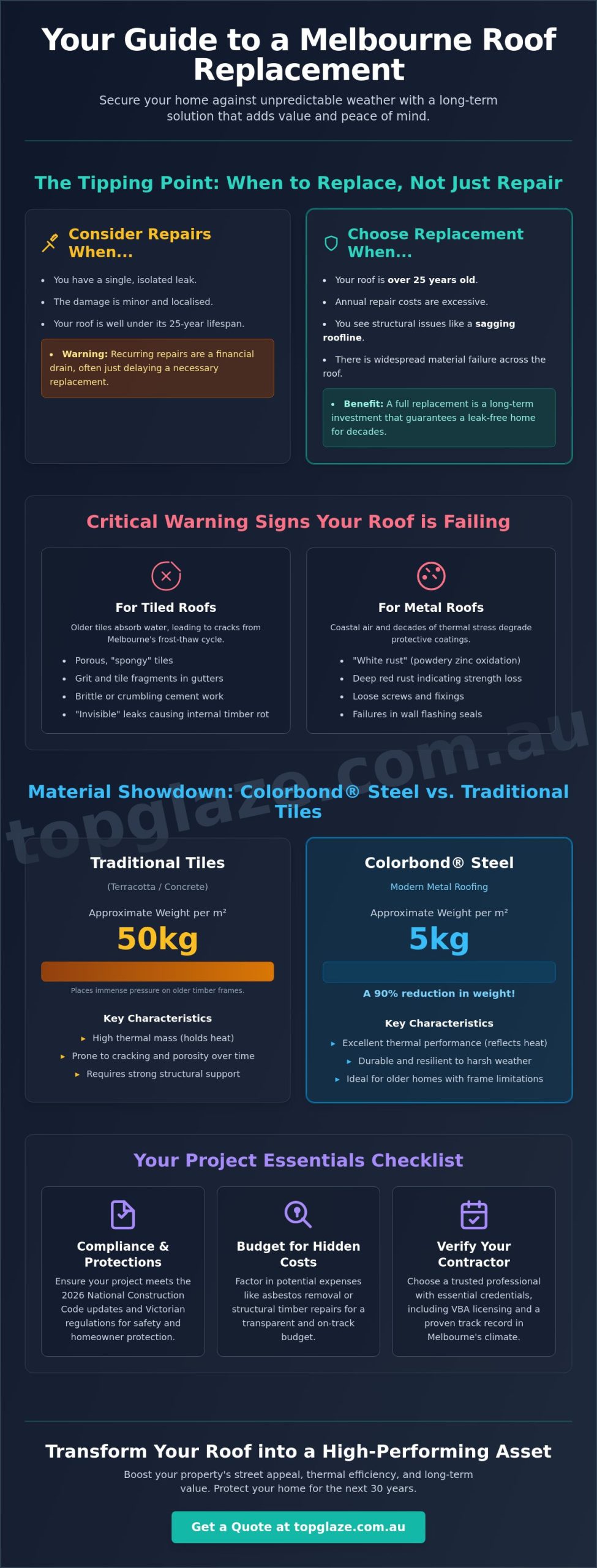
Deciding between a minor patch-up and a complete overhaul is one of the most significant financial choices you’ll make for your home. While a single leak might only require a straightforward repair, recurring issues often signal that your roofing system has reached its natural end. Most residential structures are designed with a 25-year industry benchmark in mind. Once you cross this threshold, the internal components, like the sarking and timber battens, begin to degrade regardless of how “clean” the surface looks. If you’re spending more on annual maintenance than you would on a standard finance repayment, you’ve hit the tipping point where a roof replacement melbourne becomes the more fiscally responsible path.
Structural warning signs are often subtle before they become catastrophic. A sagging roofline is a clear indicator that the underlying support structure is under stress, often due to decades of water absorption or heavy tile weight. When battens become compromised by rot, they lose their ability to hold fixings securely. This creates a safety risk during high-wind events. We often see homeowners trapped in a cycle of “patching” because they fear the initial cost, but ignoring these systemic failures usually leads to much more expensive internal ceiling collapses and electrical damage.
The Problem with Porous Tiles and Brittle Cement
Older terracotta and concrete tiles are prone to becoming “porous” over time. In Melbourne’s damp winters, these tiles soak up water like a sponge. When the temperature drops, the moisture inside the tile freezes and expands, creating micro-cracks that eventually shatter the material. This frost-thaw cycle is why many commercially available roofing materials eventually fail in our local climate. While re-pointing the ridge caps might make the roof look tidy, it won’t stop a porous tile from weeping moisture directly onto your ceiling joists. This “invisible” leaking is the primary cause of internal timber rot, which can go undetected for years until the structural integrity of the home is at risk. For a deeper understanding of how to identify early signs of tile failure before they become emergencies, our guide to roof tile roofing in Melbourne covers the essential warning signs every homeowner should know.
Visible Signs of Metal Roof Fatigue
Metal roofs aren’t immune to the passage of time, especially in coastal Melbourne suburbs where salt spray accelerates corrosion. You should look for “white rust,” which is a powdery zinc oxidation that indicates the protective coating has worn through. Once deep oxidation turns into red rust, the metal has lost its structural strength and can no longer be reliably sealed. Loose fixings and failures in the wall-flashing are also signs that the entire system is moving more than it should. Structural roof fatigue is the gradual degradation of a roofing system’s integrity caused by decades of Melbourne’s extreme thermal expansion and contraction, eventually leading to material failure that no simple patch can resolve. When these signs appear across multiple sheets, a full roof replacement melbourne is the only way to guarantee a leak-free home for the next three decades.
Comparing Roofing Materials: Tile vs. Colorbond Steel
Choosing the right material for your roof replacement melbourne is a decision that balances structural necessity with long-term performance. In our local climate, where a single afternoon can swing from scorching sun to a sudden hailstorm, the material you select acts as your home’s primary thermal and protective shield. For many older homes in the suburbs, the weight of the roofing material is the most critical factor. Traditional concrete or terracotta tiles can weigh up to 50kg per square metre; a load that places immense pressure on timber frames that have already been standing for half a century. In contrast, Colorbond steel weighs roughly 5kg per square metre. This 90% reduction in weight often eliminates the need for additional structural reinforcement, making metal an ideal choice for heritage renovations.
Thermal performance is another area where modern materials have surpassed older standards. While tiles have high thermal mass, meaning they hold onto heat long after the sun has set, modern metal roofing with integrated reflective technology can significantly reduce cooling costs. This shift is particularly noticeable during Melbourne’s heatwaves. While switching from tile to metal is a common trend, you should always check the local building permit requirements for your specific council area, as structural changes or alterations to the home’s external appearance often require official approval. If you’re torn between the classic look of tile and the modern efficiency of steel, speaking with a local specialist can help clarify the best fit for your specific property.
The Rise of Colorbond in Melbourne Suburbs
The “Tile to Colorbond” conversion has become a massive trend across the Inner North and Bayside suburbs. Homeowners are increasingly prioritising the sleek, modern street appeal of genuine BlueScope steel. Beyond aesthetics, the maintenance profile of Colorbond over a 30-year lifecycle is remarkably low. It doesn’t crack, it isn’t prone to the “porous” failure mentioned in previous sections, and it’s 100% recyclable. Popular colours like Monument and Shale Grey have become the standard for contemporary Melbourne architecture, providing a clean finish that complements both red-brick Edwardians and modern rendered builds.
Terracotta and Concrete Tile: The Traditional Choice
Despite the move toward metal, terracotta and concrete tiles remain the preferred choice for maintaining the heritage value of specific Melbourne precincts. There’s an undeniable acoustic benefit to tile; the density of the material naturally dampens the sound of heavy rain and hailstones, providing a quieter interior environment. Modern glazed tiles are also far more resilient than the vintage materials found on homes built in the 1960s. When installed with high-quality sarking and modern flexible pointing, a new roof tile roofing system can provide the same 30-plus years of security as metal while preserving the original character of a classic California Bungalow or Federation home.
The Step-by-Step Roof Replacement Process
A professional roof replacement melbourne follows a methodical sequence to ensure the structural integrity of your home remains intact throughout the transition. The process begins long before the first tile is lifted. A comprehensive site assessment identifies potential access issues and ensures that the perimeter is secured. We then install heavy-duty safety guardrails around the roofline. This is a non-negotiable requirement under Victorian law to protect the tradespeople working on your home and to ensure the project remains fully compliant with WorkSafe standards.
Once the site is secured, the careful removal of old materials begins. If your home was built before 1990, there is a possibility of asbestos-containing materials in the eaves or old cement sheets. We handle this phase with extreme caution, utilising specialised disposal methods to prevent any contamination of your property. Following the removal, we conduct a deep structural inspection of the timber frame. Any sagging battens or water-damaged rafters are replaced at this stage to provide a perfectly level foundation for your new roof. This level of detail is supported by industry best practices, such as those outlined in the ARTA Reroofing Factsheet, which emphasises the importance of a sound substrate before laying new materials.
Safety and Council Compliance in Victoria
Safety isn’t just about the workers; it’s about protecting your assets. Guardrails are essential for any roof replacement melbourne project because they prevent falls and allow for the efficient movement of materials. Our team adheres strictly to Victorian Building Authority (VBA) standards, ensuring that every fastener and flashing meets the current National Construction Code. Top Glaze also prioritises a “leave no trace” policy. This means we use protective tarps for your driveway and meticulously clear the site of nails and debris using magnetic sweeps to protect your family and vehicles.
The Critical Role of Sarking and Insulation
The 2026 energy standards have introduced stricter requirements for condensation management and thermal efficiency. High-quality foil sarking is now a standard inclusion, acting as a secondary waterproof skin and a reflective barrier against radiant heat. This phase is also the ideal time to upgrade your home’s R-rating by installing high-performance insulation batts between the rafters. Sarking plays a vital role by collecting any condensation that forms under the roof sheets and directing it into the gutters, preventing moisture from dripping onto your ceiling during Melbourne’s rapid temperature shifts. Finally, the chosen materials are laid and integrated with new guttering and fascia to create a seamless, weather-tight seal.
Budgeting for Your Melbourne Roof Replacement
Planning the financial side of a roof replacement melbourne requires looking past the bottom-line figure on a quote. Several variables dictate the final investment, starting with the pitch of your roof and the complexity of its design. A steep pitch or multiple gables requires more safety equipment and longer labour hours than a standard flat roof. Access also plays a role. If your home is on a narrow street in a suburb like Richmond or has limited side access, the logistics of material delivery and waste removal can influence the total cost. We recommend budgeting for a contingency of roughly 10% to cover hidden issues like rotted valley boards or compromised structural timber that only become visible once the old materials are stripped away.
The long-term return on investment is often what surprises homeowners the most. A high-quality replacement doesn’t just stop leaks; it transforms your property’s market value. Real estate experts across Victoria frequently highlight that a new roof provides immediate street appeal, which is a major drawcard for buyers looking for a move-in ready home. Additionally, many insurance providers recognise the reduced risk of water damage associated with a modern roofing system. With the Building Legislation Amendment (Buyer Protections) Act 2025 coming into full effect on July 1, 2026, homeowners now have better statutory insurance protections for building work valued at over $20,000, providing an extra layer of financial peace of mind.
Investing in Quality: Beyond the Initial Quote
Choosing a contractor based solely on the lowest price is a gamble that rarely pays off in the Victorian climate. The cheapest quotes often omit essential components like high-grade sarking or proper flashing, which leads to leaky results within just a few seasons. Look for a team that offers a 10-year workmanship warranty to ensure you’re protected for the long haul. If you’re planning to install solar panels in the future, ensure your new roof is solar-ready by using heavy-duty fixings and appropriate batten spacing during the replacement process. To get a clear picture of your specific requirements, request a detailed onsite assessment from a local expert who understands your suburb’s specific conditions.
Financing and Planning Your Project
Timing is everything when you organise a re-roof in Victoria. While work can be done year-round, many homeowners prefer the stable conditions of autumn or spring to minimise weather-related delays. A full replacement is also the most cost-effective time to integrate other upgrades. For instance, the new ceiling insulation rebate introduced in late 2026 offers approximately $1,500 for eligible households, which can significantly offset the cost of upgrading your home’s R-rating. Combining your project with new fascia and leaf guards often prevents the future need for separate gutter repairs, saving you money on call-out fees and extra scaffolding costs later. Managing the timeline properly ensures the project is completed efficiently to keep household disruption to an absolute minimum.
Choosing a Trusted Melbourne Roofing Contractor
Selecting the right team for your roof replacement melbourne is about more than just comparing quotes. It’s about finding a partner who will still be around in a decade if you have a question. In Victoria, any major roofing work must be performed by a VBA-licenced plumber. This isn’t just a recommendation; it’s a legal requirement that ensures your project meets the National Construction Code. Always ask to see a current Certificate of Currency for public liability and consumer protection insurance. These documents are your safety net, protecting your home and your finances from unforeseen onsite accidents.
Local experience counts for everything in our temperamental climate. A contractor who has spent 30 years working in Melbourne understands how the salt air of the Bayside suburbs differs from the frost-prone hills of the Outer East. While online reviews provide a helpful starting point, you should look for detailed testimonials that mention specific challenges, such as how the team handled a sudden storm mid-project. A physical showroom or local office is another hallmark of a stable business. It provides a level of accountability that a mobile-only operator simply cannot match, giving you a place to visit and see material samples in person before the work begins.
The Top Glaze Difference: 30 Years of Local Expertise
At Top Glaze, we’ve built our reputation as a reliable guardian of the home across the Mornington Peninsula and the greater Melbourne area. We believe that a roof replacement melbourne should be a stress-free experience, which is why we’ve moved away from the high-pressure sales tactics common in the industry. Our approach is based on transparency and seasoned advice. We provide a definitive 10-year workmanship guarantee on our projects, backed by three decades of proven results. This commitment to quality ensures that your investment provides the peace of mind you deserve for years to come.
Questions to Ask Before Signing a Contract
Before you commit to a project, it’s vital to clarify the logistics to avoid surprise expenses. Use this checklist during your final consultation to ensure every detail is covered:
- Is the waste removal and site cleanup included in the total price?
- Who is the dedicated onsite supervisor for my project?
- How will you protect my garden and driveway during the material removal phase?
- Can you provide a VBA compliance certificate upon completion?
Book your free Melbourne roof assessment with Top Glaze today to receive a professional evaluation from a team that knows our city’s roofs better than anyone else.
Securing Your Melbourne Home for the Next Generation
Investing in a high-quality roof replacement melbourne is the most effective way to eliminate the recurring anxiety of storm season while protecting your home’s structural integrity. By selecting between modern Colorbond steel or classic terracotta, you are doing more than just fixing a leak; you are significantly improving your home’s thermal efficiency and long-term market value. Understanding the 2026 building regulations and insulation rebates ensures your project is fully compliant and prepared for the extremes of Victorian weather.
Our team brings seasoned authority to every residential project, drawing on over 30 years of experience in the local industry. We provide the certainty that comes from working with fully licensed and insured VBA practitioners, and we back every replacement with a 10-year warranty. You don’t have to settle for another year of temporary patches and mounting repair bills. Take the first step toward a permanent solution and a worry-free home today; Get Your Obligation-Free Roof Replacement Quote and see how easy the process can be with the right experts by your side. We look forward to helping you protect your home for years to come.
Frequently Asked Questions
How much does a roof replacement cost in Melbourne?
The total investment for a roof replacement melbourne depends on several variables including the square metreage of the home, the pitch of the roof, and the complexity of the design. Factors such as site access and the choice between concrete tiles or Colorbond steel also play a major role. Because every home is unique, we provide a detailed onsite assessment to identify any structural timber repairs or asbestos removal requirements before providing a final, transparent quote.
How long does a full roof replacement usually take?
A standard residential project typically takes between three and seven working days to complete from start to finish. This timeline includes the installation of safety guardrails, the removal of old materials, and the final integration of new guttering. While we work efficiently to minimise disruption, the schedule can shift slightly depending on Melbourne’s unpredictable weather patterns. We always ensure the roof is secured and watertight at the end of each working day.
Can I change my roof from tile to Colorbond?
Converting from tile to Colorbond is a common request and is often the best choice for older Melbourne frames. Because metal is significantly lighter than tile, it reduces the structural load on your home’s timber rafters. Our team handles the entire conversion process, which includes removing the old tiles and installing new battens to provide a level foundation for the steel sheets. This upgrade instantly modernises your home’s street appeal and long-term durability.
Do I need to move out during the roof replacement process?
You generally don’t need to move out of your home while we are working on your roof. We establish clear safety zones and manage the site to keep your daily routine as normal as possible. There will be some noise during the removal and installation phases, and we recommend moving cars out of the driveway to allow for material deliveries. Our team focuses on maintaining a clean site to protect your garden, family, and pets throughout the build.
Will a new roof improve my home’s energy efficiency?
A new roof is one of the most effective ways to lower your energy bills and improve thermal comfort. By installing modern high-performance insulation and foil sarking during the replacement, you create a superior thermal barrier that keeps your home cooler in summer and warmer in winter. Choosing reflective “cool roof” colours can further reduce radiant heat transfer, making your home much more energy-efficient and comfortable during Melbourne’s extreme temperature swings.
What is the best time of year for a roof replacement in Victoria?
While a roof replacement melbourne can be carried out at any time of year, autumn and spring are often preferred for their milder temperatures. These seasons provide more predictable working windows and reduce the impact of extreme heat or heavy winter rain on the project timeline. However, our experienced teams are equipped to manage installations year-round, ensuring your home remains protected and watertight regardless of the month you choose to start your project.
Is a permit required for a roof replacement in Melbourne?
A building permit is typically required for major structural work in Victoria, including a full roof replacement that involves changing materials or structural components. It’s a legal requirement that the work is carried out by a VBA-registered roofing plumber. We handle the necessary compliance paperwork and ensure that your project meets all current Victorian building standards, providing you with a Certificate of Compliance once the final inspection is successfully completed.
Does Top Glaze offer a warranty on new roof installations?
We provide a definitive 10-year workmanship warranty on all our residential roof replacement projects. This guarantee covers the quality of the installation and ensures that your home remains protected against leaks and structural defects. By choosing a company with over 30 years of local experience, you have the peace of mind that we’ll be here to support our work for the long term. Our commitment is rooted in excellence and your total satisfaction.


